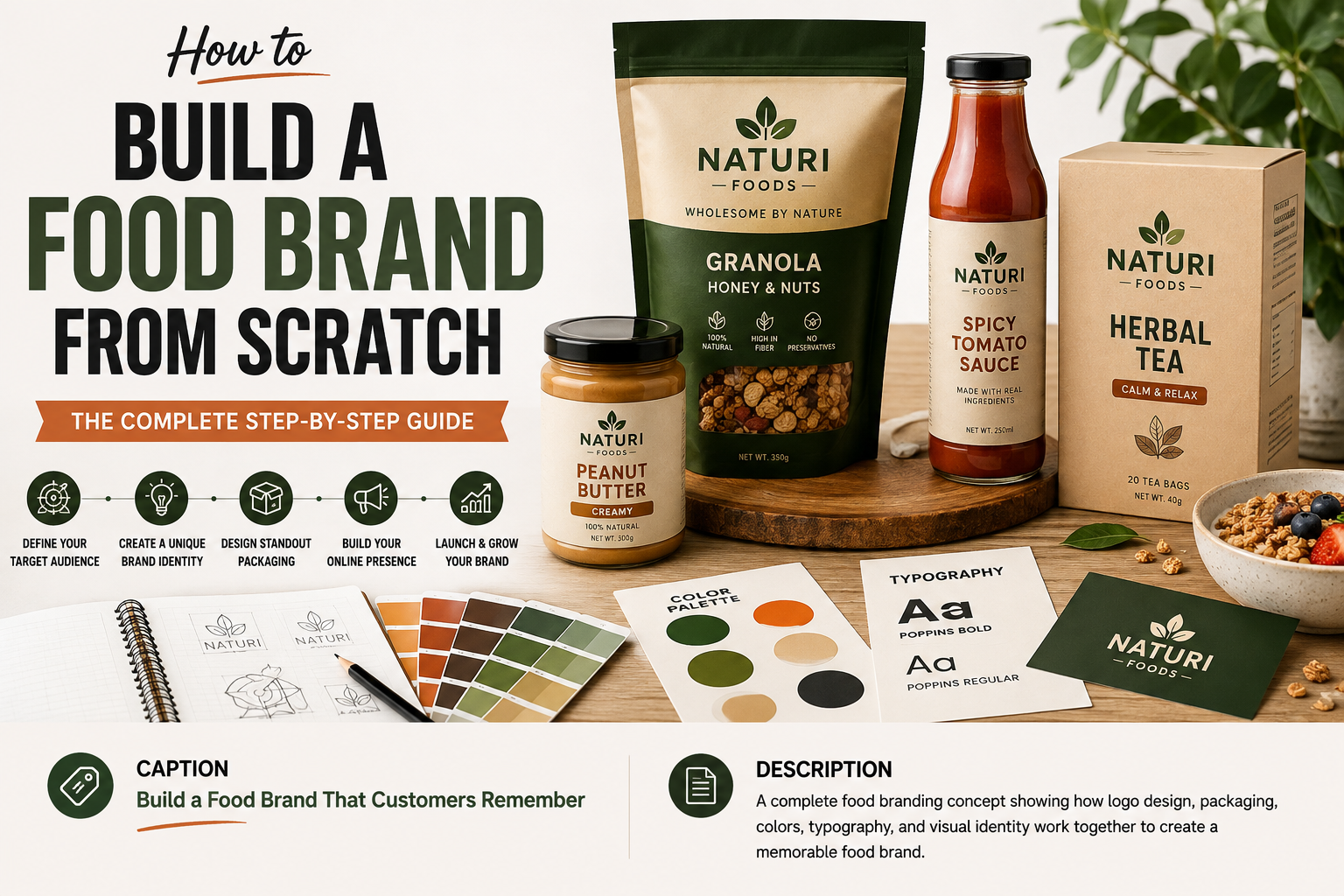
Building a food brand is about much more than creating a great product and putting a logo on the package.
A successful food brand needs a clear identity, a specific audience, memorable visuals, strong packaging, consistent messaging, and a reason for customers to choose it over competing products.
Whether you’re launching a snack, sauce, beverage, bakery product, spice brand, frozen food, or another packaged food business, the branding decisions you make early can influence how customers see your product for years.
In this guide, you’ll learn how to build a food brand from scratch, from defining your target customer and positioning your product to creating your logo, choosing brand colors, designing packaging, building an online presence, and preparing for launch.
What Is a Food Brand?
A food brand is the complete identity customers associate with a food product or food business.
It includes visible elements such as:
- Brand name
- Logo
- Colors
- Typography
- Packaging
- Product photography
- Website
- Social media visuals
But branding goes beyond design.
Your brand also includes:
- Your story
- Your values
- Your positioning
- Your customer experience
- Your messaging
- Your reputation
A logo may be the most recognizable part of a food brand, but it is only one piece of the complete brand identity.
Why Is Food Branding Important?
The food market is crowded. Customers have countless choices, and many products compete for attention in stores and online.
A strong food brand can help you:
- Stand out from competitors
- Become easier to recognize
- Communicate product quality
- Build customer trust
- Create a memorable identity
- Support premium positioning
- Make different products feel connected
- Build long-term customer loyalty
Think about brands such as McDonald’s, KFC, Coca-Cola, or Jollibee.
Customers can often recognize these brands through a combination of visual elements before they even read the complete brand name.
That recognition is the result of consistent branding over time.
Step 1: Define What Your Food Brand Sells
Before thinking about colors or logos, become very clear about your product.
Ask:
What exactly are you selling?
For example:
- Hot sauce
- Organic snacks
- Coffee
- Cookies
- Protein bars
- Frozen meals
- Spices
- Sauces
- Beverages
- Bakery products
Then identify what makes your product different.
Maybe you use a unique recipe.
Maybe your ingredients are premium.
Maybe the product is designed for convenience.
Maybe your brand focuses on a particular dietary preference.
Maybe the product is based on a family recipe.
Your differentiation will eventually influence your entire brand identity.
Step 2: Identify Your Target Audience
One of the biggest mistakes new food brands make is trying to appeal to everyone.
Instead, define exactly who you want to attract.
Think about:
- Age
- Lifestyle
- Spending habits
- Food preferences
- Location
- Buying habits
- Problems they want to solve
For example, a premium organic snack brand might target health-conscious adults who are willing to pay more for ingredients they trust.
A fun snack brand for children will require a completely different visual identity.
Your audience should influence your:
- Logo
- Colors
- Packaging
- Photography
- Brand voice
- Marketing
The better you understand your customer, the easier it becomes to make branding decisions.
Step 3: Research Your Competitors
Before creating your identity, study the brands already competing in your category.
Look at their:
- Logos
- Colors
- Packaging
- Product names
- Typography
- Photography
- Websites
- Social media
Don’t copy them.
Instead, look for patterns.
Ask:
What do most competitors have in common?
Then ask:
Where is there an opportunity to look different?
For example, if every competitor uses the same dark packaging and aggressive typography, a cleaner and more approachable identity might help your product stand apart.
Good competitor research helps you understand the category while giving you opportunities to differentiate.
Step 4: Define Your Brand Positioning
Your brand positioning answers one important question:
Why should customers choose your food brand instead of another one?
Your positioning might be based on:
- Quality
- Price
- Convenience
- Ingredients
- Tradition
- Innovation
- Sustainability
- Taste
- Lifestyle
- Heritage
Try to complete this sentence:
Our brand helps [target customer] enjoy [product/benefit] because [what makes us different].
For example:
Our brand helps busy professionals enjoy convenient healthy snacks made with simple ingredients.
This doesn’t have to become your public slogan.
It simply gives your brand a clear strategic direction.
Step 5: Choose a Memorable Food Brand Name
Your brand name is one of the first things customers will remember.
A good food brand name should ideally be:
- Easy to pronounce
- Easy to spell
- Easy to remember
- Relevant to the brand
- Distinctive
- Flexible enough to grow with the business
Avoid choosing a name only because it sounds good.
Check whether the name creates confusion with existing businesses and consider whether the corresponding domain name and social media handles are available.
If you plan to build a serious business around the name, consider getting appropriate legal advice about trademark availability before investing heavily in packaging and marketing.
What Makes a Food Brand Name Strong?
A strong name can communicate:
- Personality
- Product category
- Heritage
- Quality
- Emotion
- Lifestyle
But the name doesn’t always need to describe the food directly.
Some memorable brands use distinctive names that become meaningful through consistent branding and customer experience.
Step 6: Create Your Food Brand Logo
Once your brand strategy and name are clear, it’s time to develop the visual identity.
Your food brand logo should be recognizable, readable, and flexible.
It may appear on:
- Packaging
- Website
- Social media
- Business cards
- Menus
- Delivery bags
- Store signage
- Merchandise
A good logo should work at both large and small sizes.
It should also remain recognizable when used in different formats, including:
- Full-color
- Black
- White
- Small-size
- Horizontal
- Vertical
Don’t make the logo unnecessarily complicated.
In many cases, a simple and distinctive logo is easier for customers to remember.
Step 7: Choose Your Brand Colors
Color is another important part of food branding.
Your color palette should support your positioning rather than simply follow trends.
For example:
Green can work well for brands emphasizing natural or fresh positioning.
Red can create strong visual energy and is frequently associated with food and appetite.
Yellow can create a cheerful and approachable feeling.
Black can help communicate a premium or sophisticated positioning.
Blue can communicate freshness, reliability, or a modern feel depending on how it is used.
The key is not choosing a color because it is popular.
Choose colors that make sense for your brand and remain consistent across your packaging, website, social media, and marketing materials.
Step 8: Choose the Right Typography
Typography is often overlooked when creating a food brand.
But the fonts you choose can strongly influence how customers perceive your business.
A premium food brand may use elegant typography.
A modern snack company may use bold sans-serif fonts.
A traditional food business may use typography inspired by heritage or craftsmanship.
Whatever direction you choose, prioritize readability.
Your customers should be able to quickly identify:
- Brand name
- Product name
- Flavor
- Important product information
Avoid using too many fonts.
A simple typography system with a primary and secondary typeface is usually easier to maintain.
Step 9: Build a Complete Brand Identity
Your logo alone is not your brand identity.
A complete food brand identity can include:
- Logo system
- Color palette
- Typography
- Photography style
- Illustration style
- Icons
- Patterns
- Packaging style
- Brand voice
- Social media templates
The purpose is to create a recognizable system.
If someone sees your website without seeing your logo, the design should still feel like your brand.
The same should happen when they see your packaging or social media posts.
This consistency helps build recognition over time.
Step 10: Design Your Food Packaging
Packaging is where your branding becomes physical.
It needs to perform two jobs at the same time:
Protect the product and communicate the brand.
Good food packaging should make it easy for customers to understand:
- What the product is
- What brand made it
- What makes it different
- Which flavor or variant it is
- Important product information
Your packaging should also work within the visual environment where customers will see it.
If your product will be sold in stores, test the design next to competing products.
Ask:
Would someone notice my product when it is surrounded by twenty similar products?
If the answer is no, the design needs another round of refinement.
For more detail, see our guide on Food Packaging Design: How to Make Your Product Stand Out on the Shelf.
Step 11: Create a Brand Story
People don’t only buy food because of its ingredients.
They can also connect with the story behind the product.
Your story might begin with:
- A family recipe
- A personal experience
- A cultural tradition
- A problem you wanted to solve
- A passion for a particular ingredient
- A desire to create a better alternative
Your story should be authentic.
Don’t create a complicated story simply because it sounds impressive.
Explain:
Why did you start this brand?
What do you believe?
What do you want customers to experience?
A simple and genuine story can make a food brand feel more human.
Step 12: Develop Your Brand Voice
Your brand needs a consistent way of communicating.
Decide whether your voice should be:
- Friendly
- Playful
- Premium
- Educational
- Traditional
- Bold
- Minimal
- Energetic
For example, a luxury chocolate brand probably shouldn’t communicate exactly like a playful children’s snack brand.
Your brand voice should match your audience and positioning.
Use it consistently across:
- Website copy
- Packaging
- Social media
- Emails
- Advertisements
- Product descriptions
Step 13: Create Professional Product Photography
Food is visual.
Customers want to see what they’re buying.
High-quality product photography can help communicate:
- Texture
- Ingredients
- Serving ideas
- Product quality
- Brand personality
You don’t necessarily need a huge photography budget.
Even a simple setup can work if the lighting, composition, background, and styling are consistent.
Create a photography style that matches your brand.
A premium brand might use clean studio photography.
A natural food brand might use warm lifestyle photography.
A fun snack brand might use colorful, energetic compositions.
Step 14: Build Your Online Presence
Your website should provide a consistent digital version of your physical brand.
At minimum, customers should be able to understand:
- What your brand sells
- Who it’s for
- What makes it different
- Where to buy it
- How to contact you
Your website should use the same:
- Logo
- Colors
- Typography
- Photography
- Brand voice
as your packaging.
Social media should follow the same visual system.
This makes the brand easier to recognize across different platforms.
Step 15: Create a Consistent Social Media Identity
Social media is another opportunity to reinforce your brand.
Don’t make every post look completely different.
Instead, create repeatable design elements such as:
- Consistent colors
- Recognizable typography
- Product photography style
- Logo placement
- Graphic templates
- Recurring content formats
Your goal is for customers to recognize your content before they even read the account name.
Step 16: Test Your Brand Before Launch
Don’t wait until after launch to discover that customers don’t understand your product.
Test your branding with real people.
Show them:
- Logo
- Packaging
- Product name
- Website
- Social media graphics
Then ask simple questions.
What do you think this product is?
Who do you think this product is for?
What price range does the packaging suggest?
What do you remember after looking at it for a few seconds?
The answers can reveal problems that you may not notice because you’re too close to the project.
Step 17: Create a Brand Style Guide
Once your identity is finalized, document it.
A simple brand style guide can include:
Logo Rules
Where and how the logo can be used.
Colors
Primary and secondary colors with their digital and print specifications.
Typography
Primary and secondary fonts with usage examples.
Photography
Examples of approved image styles.
Brand Voice
Words and communication styles that fit the brand.
Packaging
Rules for maintaining consistency across different products.
This becomes especially important as the business grows and more designers, marketers, printers, or agencies work with the brand.
Step 18: Keep Every Product in the Same Brand Family
If you eventually launch multiple products, consistency becomes even more important.
Imagine a snack company with six flavors.
Each package can have its own flavor color and product image.
But the:
- Logo
- Typography
- Layout
- Brand colors
- Graphic style
should remain connected.
This creates a recognizable product family.
Customers should be able to look at the shelf and immediately understand that several different products belong to the same company.
Common Food Branding Mistakes to Avoid
1. Starting With the Logo
Don’t design a logo before understanding the brand.
Strategy should come before decoration.
2. Trying to Appeal to Everyone
A specific audience usually gives you a clearer direction than trying to satisfy everyone.
3. Copying Competitors
Research competitors, but don’t build a brand that looks like a slightly different version of another company.
4. Using Too Many Colors
A large color palette can make the brand inconsistent.
5. Using Too Many Fonts
Multiple fonts can make packaging and marketing materials feel unprofessional.
6. Ignoring Packaging
A beautiful logo can still fail if the packaging doesn’t communicate the product clearly.
7. Changing the Brand Constantly
Constant redesigns make it harder for customers to build recognition.
8. Forgetting the Customer
Branding should ultimately serve the customer, not just the designer.
How Much Does It Cost to Build a Food Brand?
There isn’t one fixed price.
The cost depends on the size and complexity of the project.
A small food business may start with:
- Brand name
- Basic logo
- Color palette
- Typography
- Simple packaging
- Basic website
A larger food company may need:
- Full brand strategy
- Professional logo system
- Complete visual identity
- Multiple packaging formats
- Product photography
- Website design
- Brand guidelines
- Marketing assets
The important thing is to prioritize the elements that customers will interact with most frequently.
For a packaged food product, packaging and visual identity are usually especially important because they represent the brand directly at the point of purchase.
Food Brand Launch Checklist
Before launching, make sure you have:
- A clear target audience
- A defined brand position
- A memorable brand name
- A professional logo
- A consistent color palette
- A readable typography system
- A clear brand story
- A consistent brand voice
- Professional packaging
- Product photography
- A website or landing page
- Social media profiles
- Consistent marketing materials
- A basic brand style guide
- Tested your branding with potential customers
Final Thoughts
Learning how to build a food brand from scratch is not about creating one beautiful logo.
It’s about building a complete system that customers can recognize, understand, and remember.
Start with your audience and positioning.
Then develop your name, logo, colors, typography, packaging, story, photography, website, and marketing around the same strategy.
Most importantly, stay consistent.
A food brand becomes stronger every time customers encounter the same recognizable identity across packaging, websites, social media, stores, and advertising.
And that’s what turns a food product into a memorable brand.
Frequently Asked Questions
How do I start a food brand from scratch?
Start by defining your product, target audience, competitors, and unique positioning. Then develop your brand name, logo, visual identity, packaging, messaging, website, and marketing strategy.
What is the most important part of food branding?
There isn’t one single element. Strong food branding comes from combining a clear brand strategy with a consistent visual identity, packaging, messaging, and customer experience.
Do I need a logo before launching a food product?
A professional logo is important for building recognition, but you should develop the brand strategy first. The logo should reflect the positioning and personality of the brand.
How can a small food business look professional?
Focus on consistency. Use a clear logo, limited color palette, readable typography, professional packaging, high-quality photography, and the same visual identity across your website and social media.
How important is packaging for a food brand?
Packaging is extremely important for packaged food because it protects the product while also communicating the brand, product information, quality, and positioning.
Can I rebrand my food business later?
Yes. Food businesses can rebrand as they grow, but major changes should be planned carefully so existing customers can still recognize the brand.
What should I do after creating my food brand?
After establishing the core identity, test the branding, finalize packaging, build your online presence, prepare marketing materials, and create a consistent launch strategy.
