
Finding investors is only the first step. Once you have identified potential investors for your food business, the next challenge is getting them interested enough to hear your story.
That is where a food business pitch deck can make a big difference.
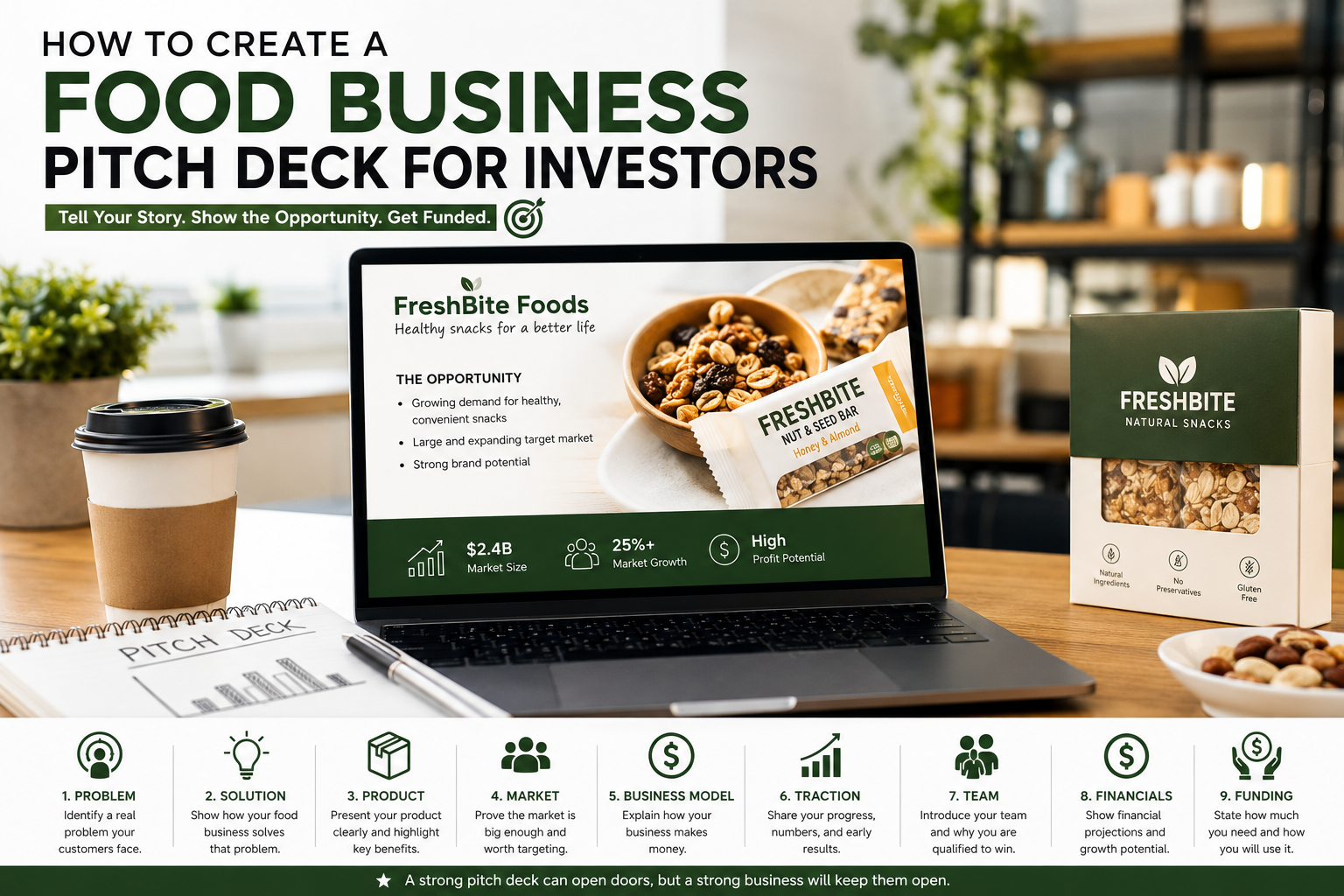
A pitch deck is a short presentation that explains what your food business does, who your customers are, why your business can grow, and how much funding you are looking for. It gives investors a quick understanding of your business before they decide whether they want to learn more.
You do not need a complicated presentation filled with dozens of slides. What you need is a clear story backed by realistic numbers.
In this guide, we will explain how to create a food business pitch deck that can help you present your idea professionally to potential investors in the USA.
What Is a Food Business Pitch Deck?
A food business pitch deck is a presentation designed to introduce your business to potential investors.
Depending on your business, it might be used for:
- A food product brand
- A packaged food company
- A restaurant concept
- A food truck business
- A catering company
- A specialty food business
- A food manufacturing company
- A food delivery or food-tech business
The purpose is not to explain every detail of your business.
Instead, your pitch deck should answer the questions an investor is likely to have:
What are you selling?
Who will buy it?
Why will they choose your product?
How big is the opportunity?
How does the business make money?
What makes your business different?
How much money are you raising?
What will you do with the investment?
A good pitch deck makes these answers easy to understand.
How Many Slides Should a Food Business Pitch Deck Have?
There is no single required number of slides, but keeping your presentation relatively short is usually a good approach.
For many early-stage food businesses, around 10 to 15 focused slides can be enough to tell the story without overwhelming the investor.
You can use the following structure:
- Cover slide
- The food business problem
- Your solution
- Product
- Target customers
- Market opportunity
- Business model
- Competition
- Marketing and sales strategy
- Traction
- Team
- Financial projections
- Funding request
- Use of funds
- Closing slide
You do not necessarily need every slide. The exact structure should depend on how developed your business is.
For example, a new food product with no sales will need to explain its opportunity and strategy differently from an established food company that already has customers and revenue.
1. Start With a Strong Cover Slide
The first slide should be simple.
Include:
- Your food business name
- Logo
- Short tagline
- Your name and position
- Contact information
If you are selling a physical food product, this is also a good place to show a high-quality product image.
For example:
FreshBite Foods
Healthy Snacks Made for Busy Families
Try not to fill the first slide with unnecessary information. The goal is simply to introduce the business and create a professional first impression.
2. Explain the Problem
Investors need to understand why your product or business needs to exist.
Start by explaining the problem your target customers are experiencing.
For example, imagine you are launching a healthy snack brand.
Instead of saying:
“We sell healthy snacks.”
You could explain:
“Busy parents are looking for convenient snacks with simple ingredients, but many affordable options are high in added sugar.”
That immediately gives the investor some context.
Your problem slide should answer:
- What problem exists?
- Who experiences it?
- How serious is the problem?
- Why are existing solutions not good enough?
Do not invent a problem simply because you need one for the presentation. Your claim should be supported by customer research, industry information, surveys, sales data, or other credible evidence.
The SBA recommends using market research to understand customer demand, market size, pricing, competition, and other factors before launching or expanding a business.
3. Present Your Solution
Now introduce your food business as the solution.
Explain what you are offering and why it solves the customer’s problem.
For example:
Our Solution
FreshBite Foods produces convenient snack packs made with simple ingredients and designed for families looking for better everyday snack options.
Keep this slide easy to understand.
An investor should be able to look at it for a few seconds and understand what your company does.
4. Show Your Product
For a food business, the product itself is extremely important.
Use this slide to show:
- Product photos
- Packaging
- Flavors or varieties
- Product sizes
- Pricing
- Main ingredients or features
- What makes the product different
If you already have physical products, professional photographs can make your pitch much stronger.
If you are still developing the product, show prototypes, packaging concepts, product samples, or other visuals that help investors understand what you are building.
Avoid using generic stock images when you can show the actual product.
5. Identify Your Target Customer
Do not tell investors that your product is “for everyone.”
A stronger pitch identifies a specific customer.
For example:
Target Customer
- Parents with children
- Ages 25–45
- Middle-income and upper-income households
- Health-conscious consumers
- Primarily shopping through grocery stores and online channels
You can also explain where these customers shop and how they currently purchase similar products.
The more clearly you understand your customer, the easier it becomes to explain your marketing strategy and sales potential.
6. Explain the Market Opportunity
This is one of the most important sections of your pitch deck.
Investors want to know whether there is enough demand to build a meaningful business.
You can discuss:
- Industry size
- Target market
- Customer demand
- Market growth
- Consumer trends
- Geographic opportunity
- Competitor performance
But avoid throwing huge market numbers onto a slide without explaining what they mean for your company.
For example, saying:
“The U.S. food industry is worth hundreds of billions of dollars.”
does not automatically prove that your particular product can become successful.
Instead, explain the specific market you are targeting and how your business can realistically capture a portion of it.
7. Explain How Your Food Business Makes Money
Investors need to understand your business model.
Explain where your revenue comes from.
For example, a packaged food company might generate revenue through:
- Direct-to-consumer sales
- Online subscriptions
- Grocery stores
- Specialty retailers
- Wholesale distributors
- Restaurants
- Corporate orders
A restaurant might generate revenue through:
- In-store sales
- Takeout
- Delivery
- Catering
- Private events
Show the investor how a customer becomes revenue.
You should also explain important economics such as:
- Selling price
- Cost of goods
- Gross margin
- Average order value
- Customer acquisition cost, if known
- Repeat purchase rate, if available
This helps investors understand whether the business can actually make money as it grows.
8. Show What Makes You Different
Food is a competitive industry.
There may already be dozens or hundreds of businesses selling similar products.
Your pitch should clearly explain why customers would choose you instead.
Your advantage could come from:
- A unique recipe
- Better ingredients
- Strong branding
- Lower production costs
- A unique distribution strategy
- A specific customer niche
- Proprietary technology
- Strong customer loyalty
- Exclusive partnerships
- A differentiated product
Do not simply say:
“Our product is better than competitors.”
Explain why.
For example:
“Our product uses a shelf-stable formulation that allows us to sell through both online and retail channels without refrigerated distribution.”
A specific advantage is much more convincing than a general claim.
9. Compare Yourself With Competitors
Investors already know that competition exists.
Trying to pretend that you have no competitors can actually make your presentation look less credible.
Create a simple competitor comparison.
For example:
| Feature | Your Brand | Brand A | Brand B |
|---|---|---|---|
| Organic ingredients | Yes | Yes | No |
| Subscription option | Yes | No | Yes |
| Family-size packaging | Yes | Yes | No |
| Direct online sales | Yes | Yes | No |
Only include claims that you can verify.
The goal is not to attack competitors. It is to show where your business fits into the market.
10. Explain Your Marketing Strategy
Having a good food product does not guarantee sales.
Investors will want to know how you plan to reach customers.
Your marketing strategy might include:
- Google search
- Social media
- Influencer marketing
- Email marketing
- Retail promotions
- Sampling
- Farmers markets
- Food events
- Partnerships
- Paid advertising
- Content marketing
Explain which channels you plan to use and why.
If you already have data, even better.
For example:
“Our email list has grown to 8,000 subscribers and generates an average of 18% of monthly online sales.”
Real business data is much stronger than general marketing promises.
11. Show Traction If You Have It
Traction is evidence that people actually want your product.
If your food business is already operating, this section can become one of the strongest parts of your pitch.
You might show:
- Monthly revenue
- Revenue growth
- Number of customers
- Repeat customers
- Retail locations
- Wholesale accounts
- Online orders
- Subscription customers
- Product units sold
- Social media growth
- Email subscribers
- Customer reviews
For example:
Traction
- $185,000 in annual sales
- 3,200 customers
- 28% repeat purchase rate
- 14 retail locations
- 18% year-over-year revenue growth
If you are pre-revenue, do not make up numbers.
Instead, show other evidence of progress:
- Product prototype completed
- Test customers
- Pre-orders
- Retailer interest
- Manufacturing agreement
- Customer survey results
- Successful product testing
Investors generally want to see evidence that your idea can become a real business, not just an interesting concept.
12. Introduce Your Team
Investors are not only investing in a product.
They are investing in the people running the business.
Introduce the founders and key team members.
Include:
- Name
- Position
- Relevant experience
- Industry background
- Important achievements
For example:
Sarah Johnson — Founder & CEO
10 years of experience in food product development and retail distribution.
Mark Davis — Operations
Former operations manager with experience managing food manufacturing and supply chains.
Focus on experience that is relevant to your business.
You do not need to include someone’s entire resume.
13. Include Your Financial Projections
This is where many pitch decks become weak.
Your financial projections should be realistic and connected to the assumptions behind your business model.
You can include:
- Revenue projections
- Gross profit
- Operating expenses
- Net profit
- Cash flow
- Break-even point
For a new business, you may show projections for the next three to five years.
The SBA recommends that funding requests be supported by financial projections and that projections should match the business’s funding needs.
Do not create unrealistic projections simply to impress investors.
If you predict that revenue will grow from $100,000 to $10 million in two years, you should be able to explain exactly how that growth will happen.
14. Clearly Explain How Much Money You Need
Your funding request should be specific.
Do not simply write:
“We are looking for investors.”
Instead, explain:
We are raising $300,000 to expand production and distribution.
Then explain what you will do with the money.
For example:
- $100,000 — Production equipment
- $75,000 — Inventory and packaging
- $50,000 — Marketing
- $40,000 — Distribution
- $35,000 — Working capital
Your numbers should add up.
The SBA recommends clearly identifying the amount of funding requested, how it will be used, and whether the business is seeking debt or equity financing.
15. Be Clear About What You Are Offering Investors
If you are seeking equity investment, investors will want to know what they are receiving in return.
Depending on your situation, this could involve:
- Equity in the company
- Preferred shares
- A convertible instrument
- Another investment structure
Do not casually promise a percentage of your company without understanding the legal and financial implications.
Before agreeing to investment terms, consider speaking with a qualified attorney and financial professional who understands startup financing.
Remember that raising equity capital means giving investors an ownership interest in your company.
16. Finish With a Strong Closing Slide
Your final slide should make it easy for the investor to remember your business.
You can include:
Company Name
What you do
Why the opportunity matters
Funding required
Contact information
For example:
FreshBite Foods
Better Everyday Snacks for Busy Families
Raising $300,000 to expand production and enter 250 retail locations.
Then provide your name, email address, website, and phone number.
Keep the ending simple.
You want the investor to remember the opportunity, not a slide full of text.
Common Food Business Pitch Deck Mistakes
A good pitch deck is not only about what you include. It is also about what you avoid.
Too Much Text
Do not turn every slide into a page from your business plan.
Your pitch deck should support your presentation, not replace it.
Unrealistic Financial Numbers
Investors will question projections that appear disconnected from reality.
Make sure your assumptions are defensible.
No Clear Funding Request
If you want $250,000, say so.
If the money will be used for equipment, inventory, marketing, and hiring, explain that clearly.
Ignoring Competition
Almost every successful food business has competitors.
Show that you understand the competitive environment.
Focusing Only on the Product
A great food product is important, but investors also want to understand the customers, distribution, economics, team, and growth strategy.
Making the Deck Too Complicated
A pitch deck should be easy to follow.
If an investor cannot understand your business after going through the presentation, adding more information probably will not solve the problem.
How to Make Your Food Pitch Deck More Professional
You do not need an expensive designer to create a professional pitch deck.
Start with a clean presentation template and focus on consistency.
Use:
- One or two easy-to-read fonts
- Consistent headings
- High-quality product photos
- Simple charts
- Short paragraphs
- Plenty of white space
- Consistent branding
- Real business numbers
Your food brand’s colors and packaging can also be incorporated into the presentation.
Most importantly, make sure the design does not distract from the business story.
Prepare for Questions After the Pitch
The pitch deck is only the beginning.
An interested investor may ask questions such as:
- How did you calculate your market size?
- What is your gross margin?
- How much does it cost to acquire a customer?
- Who are your biggest competitors?
- How will you manufacture the product?
- What happens if sales grow faster than expected?
- What happens if sales are lower than expected?
- Why does your team have an advantage?
- How much money have you invested yourself?
- How will you use the investment?
- When do you expect to become profitable?
You should know the answers before meeting investors.
The SBA notes that investors may review the management team, market, products, corporate governance documents, and financial statements during due diligence.
Final Thoughts
Creating a food business pitch deck is not about making your company look bigger than it really is.
It is about presenting the opportunity clearly.
Start with the problem. Show your solution. Explain your customers and market. Demonstrate how you make money. Show your competitive advantage and traction. Then finish with realistic financial projections and a specific funding request.
If you are looking for investors in the USA, your pitch deck should give them enough information to understand your business and decide whether they want to have a deeper conversation.
And remember: your pitch deck gets the conversation started, but your business fundamentals are what ultimately make the investment opportunity attractive.
Before approaching investors, make sure your financial information, ownership structure, legal documents, and projections are accurate and ready for further review.How to Create a Food Business Pitch Deck for Investors
Finding investors is only the first step. Once you have identified potential investors for your food business, the next challenge is getting them interested enough to hear your story.
That is where a food business pitch deck can make a big difference.
A pitch deck is a short presentation that explains what your food business does, who your customers are, why your business can grow, and how much funding you are looking for. It gives investors a quick understanding of your business before they decide whether they want to learn more.
You do not need a complicated presentation filled with dozens of slides. What you need is a clear story backed by realistic numbers.
In this guide, we will explain how to create a food business pitch deck that can help you present your idea professionally to potential investors in the USA.
What Is a Food Business Pitch Deck?
A food business pitch deck is a presentation designed to introduce your business to potential investors.
Depending on your business, it might be used for:
- A food product brand
- A packaged food company
- A restaurant concept
- A food truck business
- A catering company
- A specialty food business
- A food manufacturing company
- A food delivery or food-tech business
The purpose is not to explain every detail of your business.
Instead, your pitch deck should answer the questions an investor is likely to have:
What are you selling?
Who will buy it?
Why will they choose your product?
How big is the opportunity?
How does the business make money?
What makes your business different?
How much money are you raising?
What will you do with the investment?
A good pitch deck makes these answers easy to understand.
How Many Slides Should a Food Business Pitch Deck Have?
There is no single required number of slides, but keeping your presentation relatively short is usually a good approach.
For many early-stage food businesses, around 10 to 15 focused slides can be enough to tell the story without overwhelming the investor.
You can use the following structure:
- Cover slide
- The food business problem
- Your solution
- Product
- Target customers
- Market opportunity
- Business model
- Competition
- Marketing and sales strategy
- Traction
- Team
- Financial projections
- Funding request
- Use of funds
- Closing slide
You do not necessarily need every slide. The exact structure should depend on how developed your business is.
For example, a new food product with no sales will need to explain its opportunity and strategy differently from an established food company that already has customers and revenue.
1. Start With a Strong Cover Slide
The first slide should be simple.
Include:
- Your food business name
- Logo
- Short tagline
- Your name and position
- Contact information
If you are selling a physical food product, this is also a good place to show a high-quality product image.
For example:
FreshBite Foods
Healthy Snacks Made for Busy Families
Try not to fill the first slide with unnecessary information. The goal is simply to introduce the business and create a professional first impression.
2. Explain the Problem
Investors need to understand why your product or business needs to exist.
Start by explaining the problem your target customers are experiencing.
For example, imagine you are launching a healthy snack brand.
Instead of saying:
“We sell healthy snacks.”
You could explain:
“Busy parents are looking for convenient snacks with simple ingredients, but many affordable options are high in added sugar.”
That immediately gives the investor some context.
Your problem slide should answer:
- What problem exists?
- Who experiences it?
- How serious is the problem?
- Why are existing solutions not good enough?
Do not invent a problem simply because you need one for the presentation. Your claim should be supported by customer research, industry information, surveys, sales data, or other credible evidence.
The SBA recommends using market research to understand customer demand, market size, pricing, competition, and other factors before launching or expanding a business.
3. Present Your Solution
Now introduce your food business as the solution.
Explain what you are offering and why it solves the customer’s problem.
For example:
Our Solution
FreshBite Foods produces convenient snack packs made with simple ingredients and designed for families looking for better everyday snack options.
Keep this slide easy to understand.
An investor should be able to look at it for a few seconds and understand what your company does.
4. Show Your Product
For a food business, the product itself is extremely important.
Use this slide to show:
- Product photos
- Packaging
- Flavors or varieties
- Product sizes
- Pricing
- Main ingredients or features
- What makes the product different
If you already have physical products, professional photographs can make your pitch much stronger.
If you are still developing the product, show prototypes, packaging concepts, product samples, or other visuals that help investors understand what you are building.
Avoid using generic stock images when you can show the actual product.
5. Identify Your Target Customer
Do not tell investors that your product is “for everyone.”
A stronger pitch identifies a specific customer.
For example:
Target Customer
- Parents with children
- Ages 25–45
- Middle-income and upper-income households
- Health-conscious consumers
- Primarily shopping through grocery stores and online channels
You can also explain where these customers shop and how they currently purchase similar products.
The more clearly you understand your customer, the easier it becomes to explain your marketing strategy and sales potential.
6. Explain the Market Opportunity
This is one of the most important sections of your pitch deck.
Investors want to know whether there is enough demand to build a meaningful business.
You can discuss:
- Industry size
- Target market
- Customer demand
- Market growth
- Consumer trends
- Geographic opportunity
- Competitor performance
But avoid throwing huge market numbers onto a slide without explaining what they mean for your company.
For example, saying:
“The U.S. food industry is worth hundreds of billions of dollars.”
does not automatically prove that your particular product can become successful.
Instead, explain the specific market you are targeting and how your business can realistically capture a portion of it.
7. Explain How Your Food Business Makes Money
Investors need to understand your business model.
Explain where your revenue comes from.
For example, a packaged food company might generate revenue through:
- Direct-to-consumer sales
- Online subscriptions
- Grocery stores
- Specialty retailers
- Wholesale distributors
- Restaurants
- Corporate orders
A restaurant might generate revenue through:
- In-store sales
- Takeout
- Delivery
- Catering
- Private events
Show the investor how a customer becomes revenue.
You should also explain important economics such as:
- Selling price
- Cost of goods
- Gross margin
- Average order value
- Customer acquisition cost, if known
- Repeat purchase rate, if available
This helps investors understand whether the business can actually make money as it grows.
8. Show What Makes You Different
Food is a competitive industry.
There may already be dozens or hundreds of businesses selling similar products.
Your pitch should clearly explain why customers would choose you instead.
Your advantage could come from:
- A unique recipe
- Better ingredients
- Strong branding
- Lower production costs
- A unique distribution strategy
- A specific customer niche
- Proprietary technology
- Strong customer loyalty
- Exclusive partnerships
- A differentiated product
Do not simply say:
“Our product is better than competitors.”
Explain why.
For example:
“Our product uses a shelf-stable formulation that allows us to sell through both online and retail channels without refrigerated distribution.”
A specific advantage is much more convincing than a general claim.
9. Compare Yourself With Competitors
Investors already know that competition exists.
Trying to pretend that you have no competitors can actually make your presentation look less credible.
Create a simple competitor comparison.
For example:
| Feature | Your Brand | Brand A | Brand B |
|---|---|---|---|
| Organic ingredients | Yes | Yes | No |
| Subscription option | Yes | No | Yes |
| Family-size packaging | Yes | Yes | No |
| Direct online sales | Yes | Yes | No |
Only include claims that you can verify.
The goal is not to attack competitors. It is to show where your business fits into the market.
10. Explain Your Marketing Strategy
Having a good food product does not guarantee sales.
Investors will want to know how you plan to reach customers.
Your marketing strategy might include:
- Google search
- Social media
- Influencer marketing
- Email marketing
- Retail promotions
- Sampling
- Farmers markets
- Food events
- Partnerships
- Paid advertising
- Content marketing
Explain which channels you plan to use and why.
If you already have data, even better.
For example:
“Our email list has grown to 8,000 subscribers and generates an average of 18% of monthly online sales.”
Real business data is much stronger than general marketing promises.
11. Show Traction If You Have It
Traction is evidence that people actually want your product.
If your food business is already operating, this section can become one of the strongest parts of your pitch.
You might show:
- Monthly revenue
- Revenue growth
- Number of customers
- Repeat customers
- Retail locations
- Wholesale accounts
- Online orders
- Subscription customers
- Product units sold
- Social media growth
- Email subscribers
- Customer reviews
For example:
Traction
- $185,000 in annual sales
- 3,200 customers
- 28% repeat purchase rate
- 14 retail locations
- 18% year-over-year revenue growth
If you are pre-revenue, do not make up numbers.
Instead, show other evidence of progress:
- Product prototype completed
- Test customers
- Pre-orders
- Retailer interest
- Manufacturing agreement
- Customer survey results
- Successful product testing
Investors generally want to see evidence that your idea can become a real business, not just an interesting concept.
12. Introduce Your Team
Investors are not only investing in a product.
They are investing in the people running the business.
Introduce the founders and key team members.
Include:
- Name
- Position
- Relevant experience
- Industry background
- Important achievements
For example:
Sarah Johnson — Founder & CEO
10 years of experience in food product development and retail distribution.
Mark Davis — Operations
Former operations manager with experience managing food manufacturing and supply chains.
Focus on experience that is relevant to your business.
You do not need to include someone’s entire resume.
13. Include Your Financial Projections
This is where many pitch decks become weak.
Your financial projections should be realistic and connected to the assumptions behind your business model.
You can include:
- Revenue projections
- Gross profit
- Operating expenses
- Net profit
- Cash flow
- Break-even point
For a new business, you may show projections for the next three to five years.
The SBA recommends that funding requests be supported by financial projections and that projections should match the business’s funding needs.
Do not create unrealistic projections simply to impress investors.
If you predict that revenue will grow from $100,000 to $10 million in two years, you should be able to explain exactly how that growth will happen.
14. Clearly Explain How Much Money You Need
Your funding request should be specific.
Do not simply write:
“We are looking for investors.”
Instead, explain:
We are raising $300,000 to expand production and distribution.
Then explain what you will do with the money.
For example:
- $100,000 — Production equipment
- $75,000 — Inventory and packaging
- $50,000 — Marketing
- $40,000 — Distribution
- $35,000 — Working capital
Your numbers should add up.
The SBA recommends clearly identifying the amount of funding requested, how it will be used, and whether the business is seeking debt or equity financing.
15. Be Clear About What You Are Offering Investors
If you are seeking equity investment, investors will want to know what they are receiving in return.
Depending on your situation, this could involve:
- Equity in the company
- Preferred shares
- A convertible instrument
- Another investment structure
Do not casually promise a percentage of your company without understanding the legal and financial implications.
Before agreeing to investment terms, consider speaking with a qualified attorney and financial professional who understands startup financing.
Remember that raising equity capital means giving investors an ownership interest in your company.
16. Finish With a Strong Closing Slide
Your final slide should make it easy for the investor to remember your business.
You can include:
Company Name
What you do
Why the opportunity matters
Funding required
Contact information
For example:
FreshBite Foods
Better Everyday Snacks for Busy Families
Raising $300,000 to expand production and enter 250 retail locations.
Then provide your name, email address, website, and phone number.
Keep the ending simple.
You want the investor to remember the opportunity, not a slide full of text.
Common Food Business Pitch Deck Mistakes
A good pitch deck is not only about what you include. It is also about what you avoid.
Too Much Text
Do not turn every slide into a page from your business plan.
Your pitch deck should support your presentation, not replace it.
Unrealistic Financial Numbers
Investors will question projections that appear disconnected from reality.
Make sure your assumptions are defensible.
No Clear Funding Request
If you want $250,000, say so.
If the money will be used for equipment, inventory, marketing, and hiring, explain that clearly.
Ignoring Competition
Almost every successful food business has competitors.
Show that you understand the competitive environment.
Focusing Only on the Product
A great food product is important, but investors also want to understand the customers, distribution, economics, team, and growth strategy.
Making the Deck Too Complicated
A pitch deck should be easy to follow.
If an investor cannot understand your business after going through the presentation, adding more information probably will not solve the problem.
How to Make Your Food Pitch Deck More Professional
You do not need an expensive designer to create a professional pitch deck.
Start with a clean presentation template and focus on consistency.
Use:
- One or two easy-to-read fonts
- Consistent headings
- High-quality product photos
- Simple charts
- Short paragraphs
- Plenty of white space
- Consistent branding
- Real business numbers
Your food brand’s colors and packaging can also be incorporated into the presentation.
Most importantly, make sure the design does not distract from the business story.
Prepare for Questions After the Pitch
The pitch deck is only the beginning.
An interested investor may ask questions such as:
- How did you calculate your market size?
- What is your gross margin?
- How much does it cost to acquire a customer?
- Who are your biggest competitors?
- How will you manufacture the product?
- What happens if sales grow faster than expected?
- What happens if sales are lower than expected?
- Why does your team have an advantage?
- How much money have you invested yourself?
- How will you use the investment?
- When do you expect to become profitable?
You should know the answers before meeting investors.
The SBA notes that investors may review the management team, market, products, corporate governance documents, and financial statements during due diligence.
Final Thoughts
Creating a food business pitch deck is not about making your company look bigger than it really is.
It is about presenting the opportunity clearly.
Start with the problem. Show your solution. Explain your customers and market. Demonstrate how you make money. Show your competitive advantage and traction. Then finish with realistic financial projections and a specific funding request.
If you are looking for investors in the USA, your pitch deck should give them enough information to understand your business and decide whether they want to have a deeper conversation.
And remember: your pitch deck gets the conversation started, but your business fundamentals are what ultimately make the investment opportunity attractive.
Before approaching investors, make sure your financial information, ownership structure, legal documents, and projections are accurate and ready for further review.
