Starting and running a food business involves much more than creating a great product. Whether you operate a food manufacturing company, bakery, packaged food brand, restaurant, catering business, or small food startup, you face different types of risks every day.
A customer could slip and fall at your location. A visitor could claim that your business caused property damage. A customer could also become ill after consuming a food product and make a claim against your business.
This is where food business liability insurance becomes important.
Two types of coverage that food businesses commonly consider are general liability insurance and product liability insurance. Although their names sound similar, they are designed to address different types of risks.
Understanding the difference between general liability insurance vs. product liability insurance can help food business owners make more informed decisions when reviewing their insurance needs.
Important: Insurance coverage depends on the specific policy, exclusions, limits, business activities, and applicable laws. This article provides general educational information and is not a substitute for advice from a qualified insurance professional.
What Is General Liability Insurance?
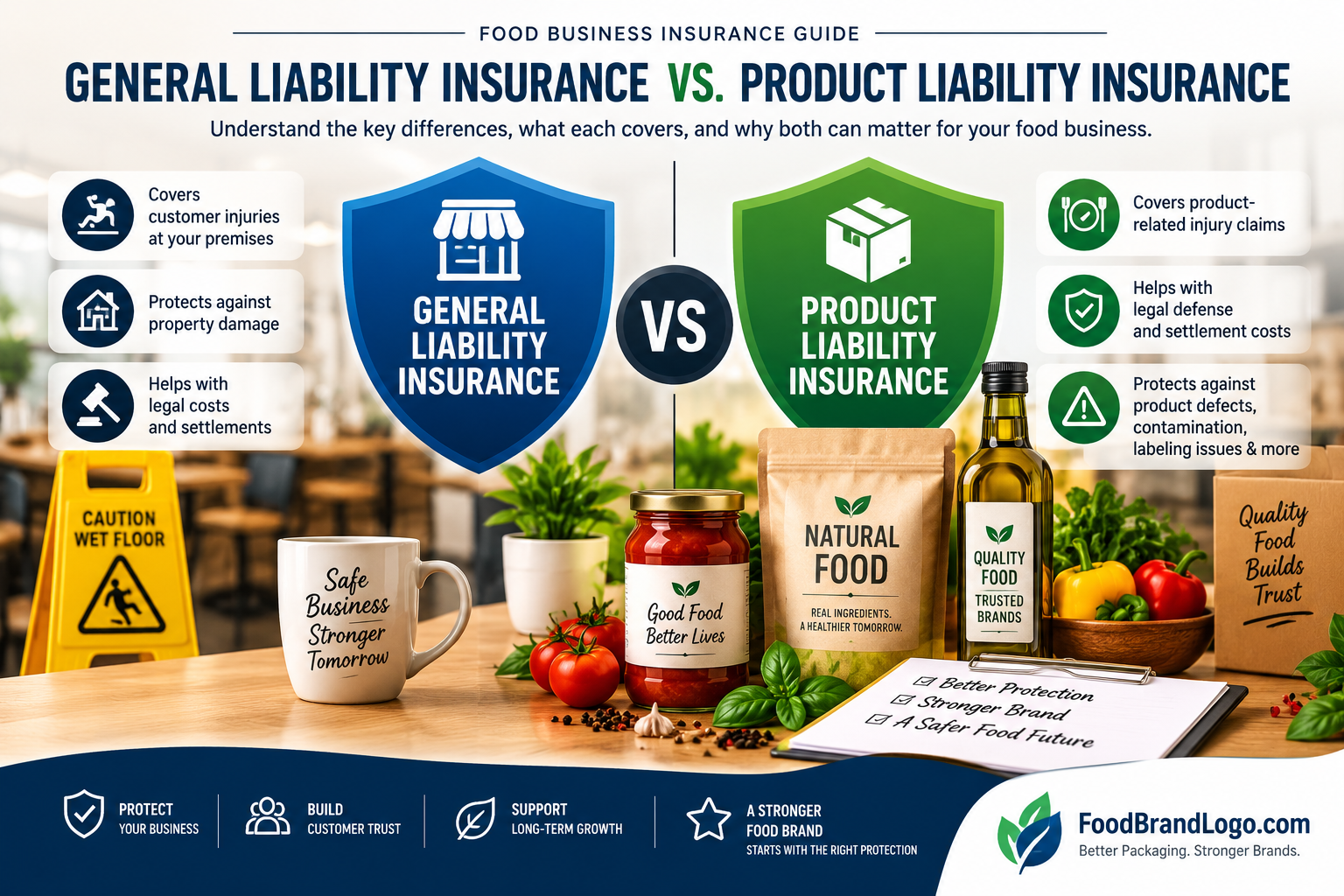
General liability insurance for food businesses is generally designed to address certain third-party claims involving bodily injury, property damage, or related liabilities arising from business operations, subject to the policy terms.
For example, imagine that a customer visits your food store and accidentally slips on a wet floor. If the customer claims that your business was responsible for the injury, a general liability policy may potentially respond to the claim, depending on the circumstances and policy coverage.
General liability coverage can be relevant to many different types of food businesses, including:
- Restaurants
- Bakeries
- Cafes
- Food trucks
- Catering companies
- Food manufacturers
- Grocery and specialty food stores
- Packaged food businesses
- Food distributors
- Small food startups
The exact protection available depends on the policy purchased.
What Is Product Liability Insurance?
Product liability insurance for food businesses focuses specifically on claims connected with products sold, supplied, manufactured, or distributed by a business.
Food products create a unique risk because customers consume them. Problems involving contamination, allergens, labeling, manufacturing, preparation, or other product-related issues can potentially lead to claims.
For example, suppose a packaged food product causes an allergic reaction because of an issue related to an undeclared allergen. A customer might make a claim against the company involved in producing or selling the product.
Product liability coverage may help address certain covered claims associated with the product, including eligible legal defense costs and damages, subject to the policy terms, limits, exclusions, and applicable law.
This makes product liability insurance particularly relevant to businesses that manufacture, package, sell, distribute, or serve food products.
General Liability vs. Product Liability: What’s the Difference?
The simplest way to understand the difference is to look at where the alleged problem comes from.
General Liability Insurance
General liability generally addresses certain third-party claims arising from the business’s premises, operations, or other covered activities.
Example:
A customer visits your bakery, slips on the floor, and claims an injury.
Product Liability Insurance
Product liability generally addresses certain third-party claims alleging that a product caused bodily injury or property damage.
Example:
A customer consumes a packaged food product and claims that the product caused an illness or allergic reaction.
So, while both types of insurance can relate to liability claims, they address different risk areas.
General Liability Insurance vs. Product Liability Insurance Comparison
| Feature | General Liability Insurance | Product Liability Insurance |
|---|---|---|
| Main purpose | Protects against certain business-related liability claims | Protects against certain product-related liability claims |
| Premises-related incidents | Often relevant | Usually not the primary purpose |
| Customer injury at business location | Potentially covered depending on policy | Not its primary focus |
| Product-related injury claim | May have some relevance depending on policy | Primary area of focus |
| Property damage claims | Potentially covered depending on circumstances | Potentially covered when product-related and covered |
| Food manufacturers | Often relevant | Particularly important |
| Restaurants | Often relevant | May also be relevant |
| Packaged food brands | Often relevant | Particularly important |
| Coverage limits | Policy-specific | Policy-specific |
The two coverages should not automatically be treated as interchangeable. A food business should review the actual policy language and discuss its specific activities with an insurance professional.
Why Food Businesses May Need Both
One of the biggest mistakes a new food business can make is assuming that one liability policy automatically covers every possible situation.
Your business may face risks from its physical location, employees, operations, customers, products, suppliers, and distribution activities.
Consider a packaged food company.
A customer visits the company’s retail location and slips on the floor. This is a different type of risk from a customer claiming that one of the company’s food products caused an injury.
The first situation may involve general liability, while the second could involve product liability.
That is why many businesses evaluate both types of coverage rather than choosing one based only on the name of the policy.
Examples of General Liability Risks for Food Businesses
Here are some common situations that may fall within the general liability area, depending on the policy:
1. Customer Slip and Fall
A customer falls inside a restaurant, bakery, store, or other business location and alleges that the business was responsible.
2. Property Damage
A business activity accidentally damages property belonging to another person or company.
3. Customer Injury on Business Premises
A visitor suffers an injury while visiting the business.
4. Advertising-Related Claims
Certain policies may also provide coverage for specified advertising or personal injury claims.
The actual coverage varies significantly between insurance policies, so food business owners should always check the policy terms.
Examples of Product Liability Risks
Product liability becomes particularly relevant when a business places food products into the marketplace.
1. Food Contamination
A customer claims that a contaminated food product caused an illness.
2. Undeclared Allergens
A consumer experiences an allergic reaction and alleges that the product contained an allergen that was not properly disclosed.
3. Manufacturing Problem
A production or packaging issue allegedly causes injury to a consumer.
4. Product Defect
A customer alleges that a defective food-related product caused bodily injury or property damage.
Again, whether a specific incident is covered depends on the policy’s definitions, exclusions, conditions, limits, and other terms.
Which Insurance Is More Important for a Food Business?
There isn’t one universal answer.
It depends on what your food business does.
A small restaurant may have significant premises and operational risks. A packaged food manufacturer may have substantial product-related risks. A food distributor may face another combination of exposures.
For example:
Restaurant:
General liability can be an important consideration, while product-related coverage may also be relevant depending on the business and policy.
Food Manufacturer:
Product liability can be particularly important because the business places manufactured food products into the marketplace.
Food Brand:
A company selling packaged products may need to evaluate product liability along with other business coverages.
Food Truck:
General liability may be important because the business interacts directly with customers at different locations, while product-related risks should also be considered.
The right insurance program should be based on the actual activities and risks of the business rather than simply choosing the cheapest policy.
How Much Does Food Business Liability Insurance Cost?
There is no single price for food business insurance.
Insurance premiums can depend on factors such as:
- Type of food business
- Annual revenue
- Number of employees
- Location
- Products sold
- Manufacturing activities
- Distribution area
- Claims history
- Coverage limits
- Deductibles
- Business experience
- Type of customers
- Policy options and exclusions
A small local bakery and a company distributing packaged food across multiple states may have very different insurance needs.
For this reason, business owners should compare quotes based on coverage and exclusions, not simply price.
What Should Food Business Owners Check Before Buying Insurance?
Before choosing a policy, consider making a checklist.
Understand Your Business Activities
Explain exactly what your business does. Do you manufacture, package, import, distribute, sell, or serve food?
Review Coverage Limits
Check how much coverage the policy provides and whether those limits are appropriate for your business.
Check Exclusions
Don’t assume every food-related claim is covered. Read the exclusions carefully.
Consider Your Distribution
If your products are sold through retailers, distributors, online stores, or multiple locations, make sure the insurer understands your distribution model.
Review Contract Requirements
Some retailers, distributors, landlords, or business partners may require specific insurance coverage or proof of insurance.
Ask About Product-Related Claims
If you manufacture or sell packaged food, specifically ask how product liability is handled under the policy.
Product Liability Insurance Is Especially Relevant to Food Brands
For businesses that create and sell their own food products, product liability deserves particular attention.
A food brand may spend months developing a product, designing its logo, creating packaging, building a website, and establishing customer trust.
But one unexpected product-related claim can create significant financial and legal challenges.
That’s why insurance should be considered as part of the broader risk-management strategy of a food business.
For more information, see our related guide:
Product Liability Insurance for Food Businesses
This article can serve as the previous article in your FoodBrandLogo insurance content series.
How Branding and Packaging Fit Into Food Business Risk
Insurance is only one part of running a professional food brand.
Your food packaging design, product information, labeling, branding, and customer communication also play important roles in presenting your product professionally.
Clear and accurate product information can help customers understand what they are buying. However, good packaging and labeling do not replace appropriate insurance coverage or professional legal and regulatory advice.
A successful food brand should therefore think about both brand presentation and business protection.
Final Thoughts
The difference between general liability insurance vs. product liability insurance comes down largely to the type of risk being addressed.
General liability insurance generally focuses on certain third-party claims connected with business operations, premises, and other covered activities. Product liability insurance focuses more specifically on certain claims arising from products sold, supplied, manufactured, or distributed by the business.
For many food businesses, considering only one type of liability exposure may leave important questions unanswered.
Whether you operate a restaurant, bakery, food truck, catering company, food manufacturing facility, or packaged food brand, understanding your potential risks is an important part of building a sustainable business.
Before purchasing coverage, speak with a qualified insurance professional who can review your business activities, policy options, limits, exclusions, and applicable requirements.
