Running a food business can be exciting, but it also comes with risks that are easy to overlook.
A customer could get sick after eating your food, a kitchen fire could damage your equipment, or an employee could get injured while working. Even a small incident can lead to expensive claims and unexpected business costs.
That’s where food business insurance comes in.
But you don’t necessarily need every type of insurance available. The right coverage depends on what kind of food business you operate, where you work, whether you have employees, and what products or services you offer.
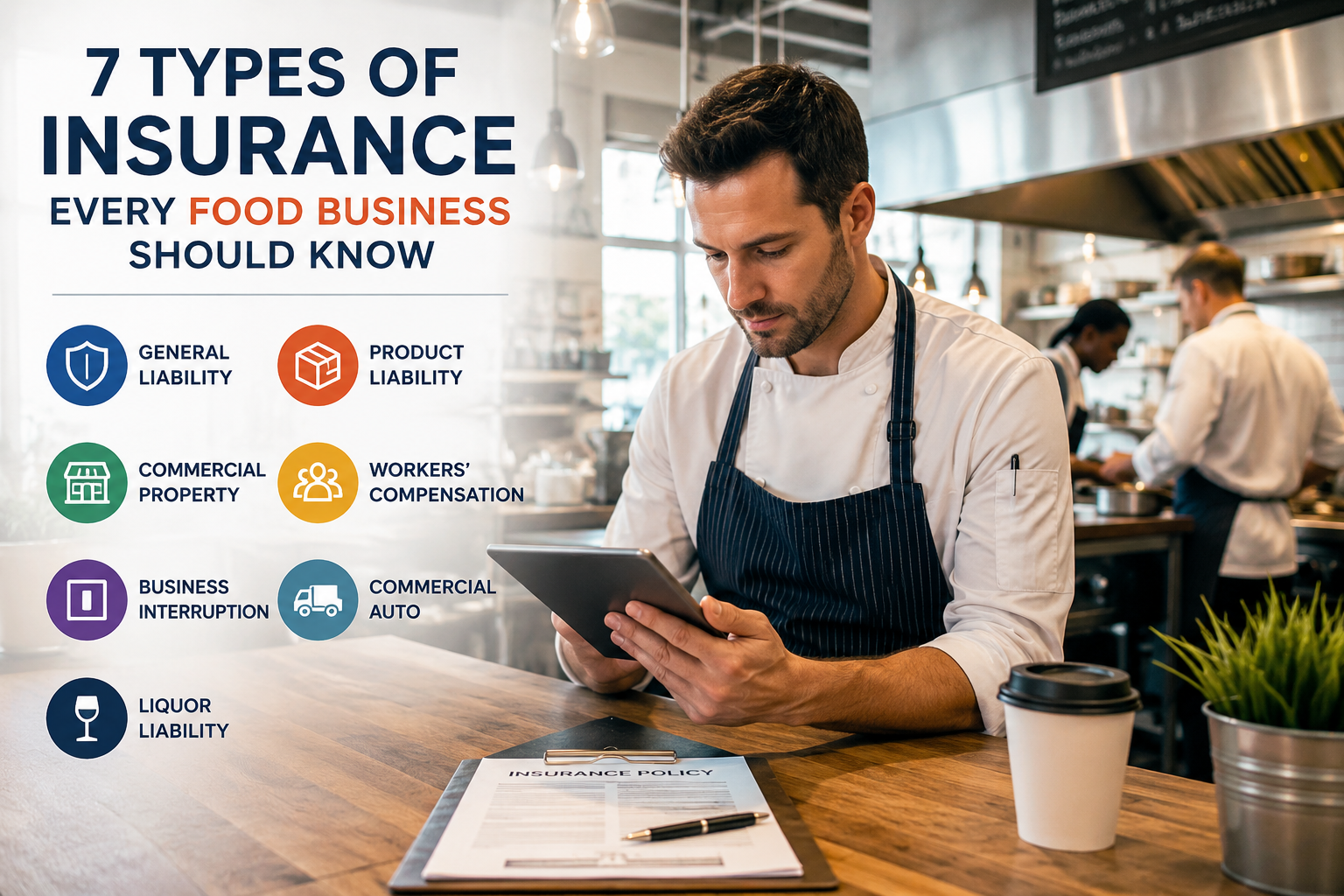
In this guide, we’ll look at 7 important types of insurance for food businesses, what each one covers, and which businesses may need it.
1. General Liability Insurance
General liability insurance is one of the most common types of coverage for food businesses.
It can help protect your business if a customer or another person claims that your business caused them bodily injury or property damage.
For example, imagine a customer visits your restaurant and slips on a wet floor. If they are injured and make a claim against your business, general liability insurance may help cover eligible legal expenses, settlements, or other covered costs.
It can also be useful if your business accidentally damages someone else’s property.
Who may need it?
General liability coverage can be useful for:
- Restaurants
- Cafes
- Bakeries
- Food trucks
- Caterers
- Food vendors
- Pop-up food businesses
- Small food manufacturers
Many landlords, event organizers, and commercial property owners may also require businesses to carry liability insurance before allowing them to operate on their premises.
2. Product Liability Insurance
Food businesses face a unique risk because they sell products that people consume.
Product liability insurance can help protect your business if a customer claims that your food product caused an injury, illness, allergic reaction, or other covered harm.
For example, suppose you sell packaged cookies and a customer claims that an undeclared ingredient caused an allergic reaction. A product liability policy may provide protection depending on the circumstances and policy terms.
This type of coverage can be particularly important for businesses that manufacture, package, distribute, or sell food products.
Businesses that may benefit from product liability coverage include:
- Packaged food brands
- Bakeries
- Food manufacturers
- Restaurants
- Meal-prep businesses
- Catering companies
- Food wholesalers
- Specialty food producers
If your business puts food products into customers’ hands, product liability deserves serious consideration.
3. Commercial Property Insurance
Your food business may depend on expensive equipment and physical property.
Think about your:
- Ovens
- Refrigerators
- Freezers
- Mixers
- Cooking equipment
- Furniture
- Computers
- Inventory
- Kitchen equipment
Commercial property insurance can help protect eligible business property against covered events such as fire, theft, or certain types of property damage.
For a restaurant or commercial kitchen, replacing equipment after a major incident could cost thousands of dollars.
That’s why property coverage can be especially valuable for businesses with significant physical assets.
4. Workers’ Compensation Insurance
If you have employees, workers’ compensation insurance may be required depending on the laws where your business operates.
Food businesses often involve physical work. Employees may work around hot surfaces, sharp knives, heavy equipment, slippery floors, and other workplace hazards.
If an employee gets injured while performing their job, workers’ compensation can help cover eligible medical expenses and lost wages according to applicable laws and the policy.
The exact requirements vary by location, business structure, and number of employees.
So if you have staff, check your local requirements rather than assuming that coverage is optional.
5. Business Interruption Insurance
What happens if your restaurant, bakery, or food production facility has to temporarily close because of a covered event?
You may still have bills to pay even though you’re not operating normally.
Rent, utilities, employee expenses, loan payments, and other costs can continue while your business is closed.
Business interruption insurance, when included or added to a suitable commercial policy, can help replace certain lost income and cover eligible ongoing expenses after a covered loss.
For example, if a covered fire forces your restaurant to close temporarily, business interruption coverage may help reduce the financial impact of the shutdown.
However, coverage varies significantly between policies, so it’s important to understand what events are actually covered.
6. Commercial Auto Insurance
If your food business uses vehicles for business purposes, personal auto insurance may not provide the protection you expect.
This can apply to businesses that use vehicles for:
- Food deliveries
- Catering
- Transportation of ingredients
- Farmers market deliveries
- Food truck operations
- Business errands
Commercial auto insurance is designed for vehicles used for business activities and may provide liability and other coverage depending on the policy.
For example, if an employee uses a company vehicle to deliver catering orders and gets into an accident, the appropriate commercial auto coverage may be important.
If you use your personal vehicle for your food business, talk to your insurer before assuming your personal policy covers business use.
7. Liquor Liability Insurance
If your food business sells or serves alcohol, liquor liability insurance may be worth considering.
Restaurants, bars, caterers, and event businesses can face additional risks when alcohol is involved.
For example, a customer who consumes alcohol at an establishment could later cause an accident or injury. Depending on local laws and the circumstances of the claim, the business could potentially face legal action.
Liquor liability requirements and laws vary significantly by location, so businesses that serve alcohol should discuss their specific situation with an insurance professional.
Do Small Food Businesses Really Need Insurance?
It’s easy to think insurance is only necessary for large restaurants or food companies.
That’s not always the case.
A small home-based bakery, food truck, catering business, or online food brand can still face unexpected risks.
In fact, smaller businesses may have fewer financial resources available to handle a major lawsuit, property loss, or business interruption.
The right insurance policy can help transfer some of those risks instead of forcing the business owner to pay every covered expense out of pocket.
However, insurance isn’t a guarantee against every possible loss. Policies have limits, exclusions, deductibles, and specific conditions.
How Much Food Business Insurance Do You Need?
There isn’t one insurance package that works for every food business.
A small bakery selling cakes locally may have very different insurance needs from a restaurant with 20 employees.
Your coverage needs may depend on:
- Type of food business
- Number of employees
- Location
- Annual revenue
- Business property
- Vehicles
- Food products
- Whether you deliver food
- Whether you serve alcohol
- Whether you rent or own your property
- Contracts with landlords or event organizers
This is why comparing policies based only on price can be a mistake.
The cheapest policy isn’t necessarily the one that provides the protection your business actually needs.
What Insurance Does a Food Truck Need?
Food trucks often need a combination of coverage because they operate differently from traditional restaurants.
Depending on the business, a food truck owner may consider:
- General liability insurance
- Product liability insurance
- Commercial auto insurance
- Commercial property or equipment coverage
- Workers’ compensation
- Business interruption coverage
Some events, festivals, and property owners may also require proof of insurance before allowing a food truck to participate.
What Insurance Does a Home-Based Food Business Need?
Home-based food businesses can have different insurance needs from traditional restaurants.
For example, a home baker may assume their homeowners or renters insurance automatically covers their business equipment and food products.
That assumption could be incorrect.
Many standard personal insurance policies have limitations or exclusions for business activities.
If you operate a food business from home, it’s worth asking an insurance professional specifically about business-related equipment, inventory, liability, and product claims.
How to Choose the Right Food Business Insurance
Choosing insurance doesn’t have to be complicated.
Start by making a list of the risks your business actually faces.
Step 1: Identify your business activities
Are you running a restaurant, food truck, bakery, catering company, or packaged food brand?
Your business type will influence the coverage you need.
Step 2: List your business assets
Make a list of equipment, inventory, vehicles, furniture, and other valuable property.
This can help you determine what needs protection.
Step 3: Think about your customers
Consider how customers interact with your business.
Do they visit your location? Do you deliver food? Do they consume packaged products?
Each activity can create different risks.
Step 4: Check legal requirements
Insurance requirements can vary depending on your location.
If you have employees, vehicles, or an alcohol license, there may be specific insurance requirements you need to meet.
Step 5: Compare coverage, not just price
When comparing quotes, look at:
- Coverage limits
- Deductibles
- Exclusions
- Policy conditions
- Additional coverage options
- Business-specific risks
A slightly more expensive policy may provide much better protection for your particular business.
Final Thoughts
Food business insurance isn’t about expecting something to go wrong.
It’s about being prepared if something does.
From a customer injury to a damaged kitchen, product claim, employee accident, or temporary shutdown, food businesses can face many different risks.
For many businesses, general liability and product liability are important starting points. Depending on your situation, you may also need property, workers’ compensation, business interruption, commercial auto, or liquor liability coverage.
The key is to choose coverage based on how your business actually operates rather than simply buying the cheapest policy available.
And if you’re still trying to understand the potential cost, check out our guide on How Much Does Food Business Insurance Cost? A Complete Guide for 2026.
Important: Insurance requirements, coverage limits, exclusions, and laws vary by location and insurance provider. This article is for general informational purposes and isn’t a substitute for professional insurance or legal advice.
