
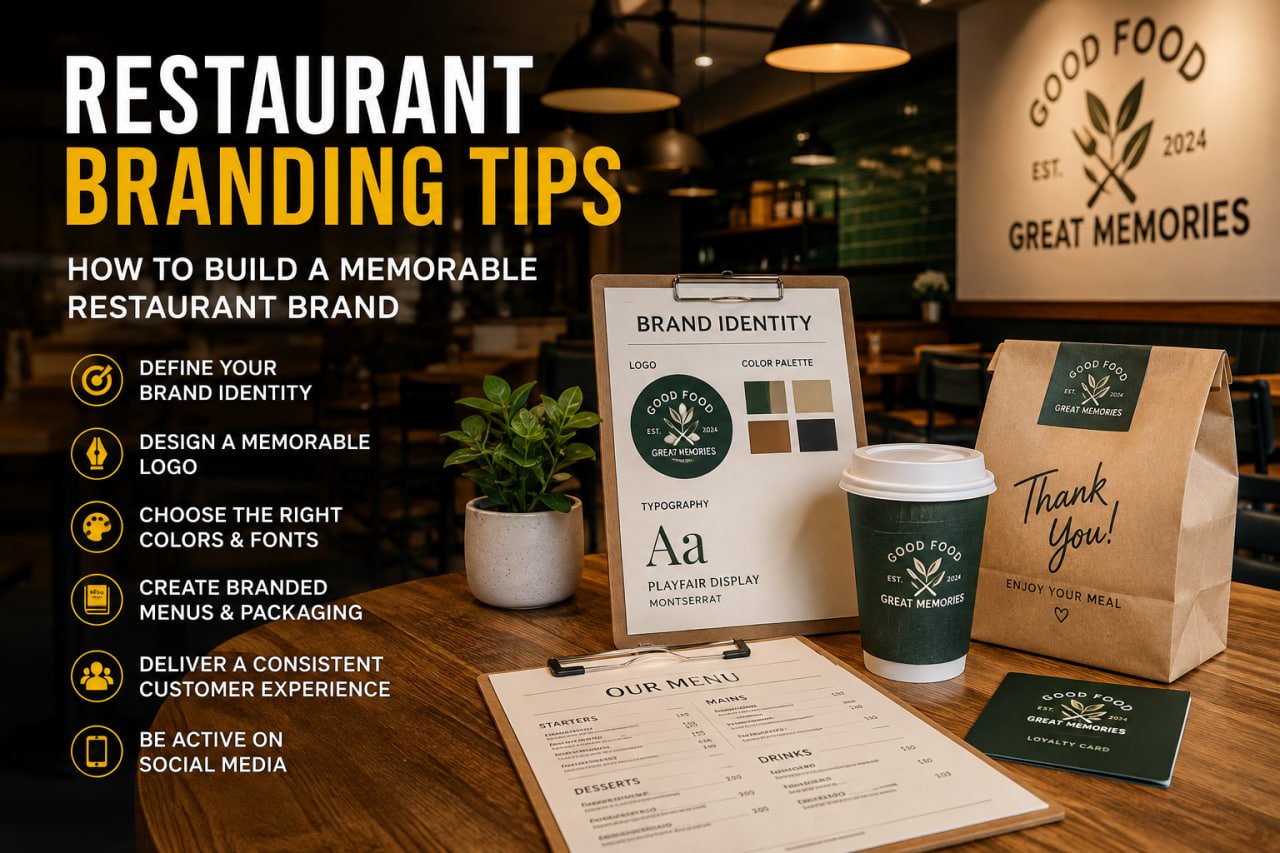
Running a restaurant is about much more than serving good food.
You can have an amazing menu, a talented kitchen team, and a great location, but if people don’t remember your restaurant—or can’t immediately tell what makes it different—it can be difficult to turn first-time visitors into loyal customers.
That’s where restaurant branding becomes important.
A strong brand gives customers a clear idea of what to expect before they even walk through the door. It can make a neighborhood burger restaurant feel casual and welcoming, a steakhouse feel premium, or a family-owned Italian restaurant feel warm and traditional.
And in a crowded restaurant market, that first impression can make a real difference.
According to the National Restaurant Association, U.S. restaurant and foodservice sales are projected to reach $1.55 trillion in 2026. At the same time, restaurants are dealing with higher operating costs and changing customer behavior.
So, how do you build a restaurant brand that people actually remember?
Let’s look at the strategies that matter most.
1. Start With a Clear Brand Identity
Before you start choosing colors, fonts, or designing a logo, take a step back and define what your restaurant actually stands for.
Ask yourself:
- What type of restaurant are we?
- Who are we trying to attract?
- What makes us different?
- What should customers feel when they see our brand?
- What kind of experience should they expect?
For example, a fast-casual burger restaurant aimed at young professionals might want to feel energetic, modern, and approachable.
A fine-dining restaurant, on the other hand, may benefit from elegant typography, understated colors, and a more sophisticated visual identity.
There isn’t one correct branding style.
The important thing is that your visual identity matches the experience customers actually receive.
If your website looks luxurious but your restaurant feels casual, customers may feel a disconnect. Your branding should set realistic expectations—not create a promise your restaurant can’t deliver.
Good branding isn’t just about looking attractive. It’s about communicating who you are.
2. Create a Restaurant Logo People Can Remember
Your logo is one of the most visible parts of your restaurant brand.
But there’s a mistake many restaurant owners make: trying to put too much information into it.
Your logo doesn’t need to explain your entire business.
It needs to be simple, recognizable, relevant, and easy to use.
Adobe’s logo design guidance explains that a good logo should be recognizable, appropriate, and practical across different sizes and applications.
Think about all the places your restaurant logo might appear:
- Restaurant signage
- Menus
- Takeout packaging
- Food delivery platforms
- Website
- Social media profiles
- Business cards
- Loyalty programs
- Merchandise
- Staff uniforms
A logo that looks great on a huge storefront sign but becomes unreadable on a smartphone isn’t doing its job.
That’s why simple and distinctive designs often have an advantage over overly complicated logos.
If you’re looking for restaurant logo ideas, studying successful food and beverage brands can help you understand how simple visual elements can become highly recognizable.
3. Choose Colors That Match Your Restaurant
Color is one of the quickest ways to communicate personality.
Think about the colors commonly used by major food brands. You’ll often see red, yellow, green, orange, black, and white—but successful brands don’t simply choose colors because they’re popular.
They choose them because the colors support the personality they want to communicate.
For example:
- Red can feel energetic and exciting.
- Green can suggest freshness, nature, or health.
- Black can create a premium or sophisticated appearance.
- Yellow and orange can feel warm, friendly, and energetic.
These aren’t strict rules. The meaning of a color depends on context, culture, audience, and how the color is combined with other design elements.
For most restaurants, you don’t need a huge color palette.
A strong restaurant visual identity might only need one primary color, one supporting color, and a neutral background.
The goal is recognition, not decoration.
4. Pick Typography That Fits Your Personality
Your restaurant’s typography communicates something about your brand before customers even read the words.
A modern sans-serif font can create a clean and contemporary feeling.
A classic serif can suggest tradition, heritage, or sophistication.
A handwritten or script style can give an artisanal or personal impression.
But there’s one rule you shouldn’t ignore:
Never sacrifice readability for style.
If customers struggle to read your restaurant name on a menu, storefront, or phone screen, the font isn’t helping your brand.
Your typography should also feel consistent across your:
- Website
- Menu
- Signage
- Social media
- Packaging
- Advertisements
Good restaurant brand design uses typography to communicate personality while keeping information easy to understand.
5. Make Your Menu Part of Your Brand
Your menu is much more than a list of dishes and prices.
It’s another opportunity to show customers what your restaurant is about.
The typography, colors, photography, descriptions, layout, and overall visual hierarchy can all affect how people perceive your business.
Imagine a neighborhood Mexican restaurant using warm colors, expressive typography, and inviting food photography.
Now compare that with a high-end restaurant using generous whitespace, elegant typography, and minimal visual elements.
Both can work.
The important thing is that the menu feels like it belongs to the same brand as the restaurant.
A well-designed menu should also make it easy for customers to understand their options and quickly find what they’re looking for.
That’s why restaurant menu design should be treated as part of the overall customer experience—not as an afterthought.
6. Keep Your Branding Consistent Everywhere
One of the easiest ways to weaken a restaurant brand is inconsistency.
Imagine seeing:
- One logo on the restaurant sign
- Another logo on the website
- Different colors on Instagram
- A completely different menu design
- Packaging that doesn’t match any of it
Each individual design might look fine, but together they don’t feel like one business.
And that makes your restaurant harder to recognize.
Customers should feel like they’re interacting with the same brand whether they’re:
- Looking at your Google listing
- Visiting your website
- Ordering takeout
- Walking into your restaurant
- Seeing an Instagram post
- Opening your delivery package
Consistency builds familiarity.
And familiarity makes a brand easier to remember.
Forbes’ discussion of brand consistency also emphasizes that consistent visual identity, messaging, and customer experience can strengthen recognition and trust.
7. Don’t Forget About Packaging
For many restaurants, the customer experience doesn’t end when the food leaves the kitchen.
Takeout and delivery have become important parts of the restaurant experience, which means packaging is another opportunity to reinforce your brand.
Your logo and visual identity can appear on:
- Burger boxes
- Pizza boxes
- Coffee cups
- Paper bags
- Stickers
- Napkins
- Sauce containers
- Delivery packaging
You don’t necessarily need expensive custom packaging for every product.
Sometimes something as simple as a branded sticker, stamp, or label can make an ordinary package feel much more intentional.
The goal is to make the experience feel connected from the restaurant all the way to the customer’s dining table.
Good restaurant packaging design turns an everyday takeout order into another memorable brand interaction.
8. Design Your Brand for Social Media
Your restaurant brand needs to work on a smartphone.
That’s especially important because customers often discover restaurants online before they ever visit them.
Your logo might appear as a tiny Instagram profile picture.
Your menu might be viewed on a phone.
Your food photographs might be shared by customers.
Your restaurant could even be discovered through a social media post before someone searches for your website.
That means your branding should be designed for digital use from the beginning.
Create logo variations that work for:
- Square social media profiles
- Website headers
- Mobile screens
- Horizontal signage
- Printed materials
A good logo shouldn’t only look impressive on a large storefront.
It should still be recognizable when reduced to a small profile icon.
That’s an important part of modern restaurant marketing and branding.
9. Study Your Competition—But Don’t Copy It
Before creating your restaurant brand, spend some time researching competitors in your market.
Look at their:
- Logos
- Colors
- Menus
- Websites
- Packaging
- Photography
- Social media
- Taglines
- Overall customer experience
The goal isn’t to copy successful restaurants.
It’s to understand what customers in your category are already seeing—and identify opportunities to look different.
For example, if every restaurant in your area uses a red circular logo with a fork icon, creating another version of the same idea probably won’t make your business memorable.
Study the category.
Then find your own lane.
This is one of the most useful restaurant branding ideas for businesses that want to build a distinctive identity.
10. Make the Customer Experience Match the Brand
This is where restaurant branding becomes much bigger than logos and colors.
Your brand is also shaped by what customers experience.
That includes:
- How staff interact with guests
- How quickly orders are handled
- How the restaurant looks and feels
- How food is presented
- How complaints are handled
- How your website communicates
- How you communicate on social media
A beautiful logo can’t compensate for a poor customer experience.
At the same time, an excellent customer experience becomes even more powerful when your visual identity supports it.
The National Restaurant Association’s 2026 industry report highlights how restaurants are navigating changing consumer behavior, cost pressures, and the importance of delivering value and experiences customers want.
Your branding promise and the real restaurant experience need to match.
11. Create a Simple Brand Style Guide
Once you’ve developed your restaurant’s identity, document it.
You don’t need a massive corporate branding manual.
A simple brand guide can include the essentials:
Logo
Your primary logo, alternate versions, and basic usage rules.
Colors
Your primary and secondary colors, including HEX, RGB, and CMYK values.
Typography
Your primary and secondary fonts and how they should be used.
Photography
Guidelines for food photography, lighting, backgrounds, and image style.
Voice
How your restaurant communicates with customers.
Visual Style
Examples of menus, social posts, packaging, advertisements, and other branded materials.
A brand guide makes it much easier to maintain consistency as your restaurant grows.
Adobe’s brand identity guidance also describes brand guides as a blueprint for maintaining consistency across elements such as logos, typography, colors, imagery, and messaging.
12. Let Your Brand Evolve Without Losing Recognition
Your restaurant doesn’t have to look exactly the same forever.
Restaurants change.
Menus evolve. New locations open. Customer preferences shift. Digital platforms change. Your business may grow into something different from what it was when you first opened.
Your branding may need to evolve too.
But there’s a big difference between a brand refresh and completely starting over.
A thoughtful refresh might involve:
- Simplifying the logo
- Updating typography
- Refinining the color palette
- Improving packaging
- Updating photography
- Creating better digital assets
The goal is to make the brand feel current while keeping the elements customers already recognize.
Final Thoughts: Build a Brand People Can Remember
Great restaurant branding doesn’t happen because you picked a trendy logo and a nice color palette.
It starts with understanding your customers, defining your personality, and creating an identity that supports the experience you want people to have.
Your logo, colors, typography, menu, packaging, website, social media, and customer experience should all tell the same story.
And you don’t need the biggest restaurant budget to create a memorable brand.
You need clarity, consistency, and a visual identity that gives customers a reason to remember you.
If you’re building or refreshing a food business, start with the basics:
Know your audience. Define your personality. Understand what makes you different. Then create a restaurant logo and visual identity that can grow with your business.
For more food logo inspiration, brand examples, and logo histories, explore FoodBrandLogo.com.
Frequently Asked Questions
What is restaurant branding?
Restaurant branding is the process of creating a recognizable and consistent identity for a restaurant through its logo, colors, typography, messaging, packaging, menu design, customer experience, and other brand touchpoints.
Why is branding important for a restaurant?
Strong branding helps a restaurant stand out from competitors, build recognition, communicate its personality, and create a more consistent customer experience.
What makes a good restaurant logo?
A good restaurant logo should be distinctive, relevant to the business, readable, versatile, and recognizable across both digital and physical applications.
What colors are best for restaurant branding?
There isn’t one universally best color for every restaurant. The right palette depends on the restaurant’s concept, audience, positioning, and personality.
Red, green, yellow, orange, black, and neutral colors can all work when they’re used intentionally.
How do I create a restaurant brand identity?
Start by defining your target customer, restaurant personality, positioning, and values.
Then build a consistent system around your logo, colors, typography, imagery, messaging, menu design, packaging, website, and social media.
Should my restaurant logo work on social media?
Yes.
Your logo should remain recognizable at small sizes and work across social media profiles, websites, delivery platforms, packaging, signage, and printed materials.
How often should a restaurant rebrand?
There is no fixed schedule.
Consider a brand refresh when your current identity no longer represents your business, target audience, market position, or customer experience.
A good refresh should improve the brand while preserving recognizable elements whenever possible.How to Build a Restaurant Brand Customers Remember
Running a restaurant is about much more than serving good food.
You can have an amazing menu, a talented kitchen team, and a great location, but if people don’t remember your restaurant—or can’t immediately tell what makes it different—it can be difficult to turn first-time visitors into loyal customers.
That’s where restaurant branding becomes important.
A strong brand gives customers a clear idea of what to expect before they even walk through the door. It can make a neighborhood burger restaurant feel casual and welcoming, a steakhouse feel premium, or a family-owned Italian restaurant feel warm and traditional.
And in a crowded restaurant market, that first impression can make a real difference.
According to the National Restaurant Association, U.S. restaurant and foodservice sales are projected to reach $1.55 trillion in 2026. At the same time, restaurants are dealing with higher operating costs and changing customer behavior.
So, how do you build a restaurant brand that people actually remember?
Let’s look at the strategies that matter most.
1. Start With a Clear Brand Identity
Before you start choosing colors, fonts, or designing a logo, take a step back and define what your restaurant actually stands for.
Ask yourself:
- What type of restaurant are we?
- Who are we trying to attract?
- What makes us different?
- What should customers feel when they see our brand?
- What kind of experience should they expect?
For example, a fast-casual burger restaurant aimed at young professionals might want to feel energetic, modern, and approachable.
A fine-dining restaurant, on the other hand, may benefit from elegant typography, understated colors, and a more sophisticated visual identity.
There isn’t one correct branding style.
The important thing is that your visual identity matches the experience customers actually receive.
If your website looks luxurious but your restaurant feels casual, customers may feel a disconnect. Your branding should set realistic expectations—not create a promise your restaurant can’t deliver.
Good branding isn’t just about looking attractive. It’s about communicating who you are.
2. Create a Restaurant Logo People Can Remember
Your logo is one of the most visible parts of your restaurant brand.
But there’s a mistake many restaurant owners make: trying to put too much information into it.
Your logo doesn’t need to explain your entire business.
It needs to be simple, recognizable, relevant, and easy to use.
Adobe’s logo design guidance explains that a good logo should be recognizable, appropriate, and practical across different sizes and applications.
Think about all the places your restaurant logo might appear:
- Restaurant signage
- Menus
- Takeout packaging
- Food delivery platforms
- Website
- Social media profiles
- Business cards
- Loyalty programs
- Merchandise
- Staff uniforms
A logo that looks great on a huge storefront sign but becomes unreadable on a smartphone isn’t doing its job.
That’s why simple and distinctive designs often have an advantage over overly complicated logos.
If you’re looking for restaurant logo ideas, studying successful food and beverage brands can help you understand how simple visual elements can become highly recognizable.
3. Choose Colors That Match Your Restaurant
Color is one of the quickest ways to communicate personality.
Think about the colors commonly used by major food brands. You’ll often see red, yellow, green, orange, black, and white—but successful brands don’t simply choose colors because they’re popular.
They choose them because the colors support the personality they want to communicate.
For example:
- Red can feel energetic and exciting.
- Green can suggest freshness, nature, or health.
- Black can create a premium or sophisticated appearance.
- Yellow and orange can feel warm, friendly, and energetic.
These aren’t strict rules. The meaning of a color depends on context, culture, audience, and how the color is combined with other design elements.
For most restaurants, you don’t need a huge color palette.
A strong restaurant visual identity might only need one primary color, one supporting color, and a neutral background.
The goal is recognition, not decoration.
4. Pick Typography That Fits Your Personality
Your restaurant’s typography communicates something about your brand before customers even read the words.
A modern sans-serif font can create a clean and contemporary feeling.
A classic serif can suggest tradition, heritage, or sophistication.
A handwritten or script style can give an artisanal or personal impression.
But there’s one rule you shouldn’t ignore:
Never sacrifice readability for style.
If customers struggle to read your restaurant name on a menu, storefront, or phone screen, the font isn’t helping your brand.
Your typography should also feel consistent across your:
- Website
- Menu
- Signage
- Social media
- Packaging
- Advertisements
Good restaurant brand design uses typography to communicate personality while keeping information easy to understand.
5. Make Your Menu Part of Your Brand
Your menu is much more than a list of dishes and prices.
It’s another opportunity to show customers what your restaurant is about.
The typography, colors, photography, descriptions, layout, and overall visual hierarchy can all affect how people perceive your business.
Imagine a neighborhood Mexican restaurant using warm colors, expressive typography, and inviting food photography.
Now compare that with a high-end restaurant using generous whitespace, elegant typography, and minimal visual elements.
Both can work.
The important thing is that the menu feels like it belongs to the same brand as the restaurant.
A well-designed menu should also make it easy for customers to understand their options and quickly find what they’re looking for.
That’s why restaurant menu design should be treated as part of the overall customer experience—not as an afterthought.
6. Keep Your Branding Consistent Everywhere
One of the easiest ways to weaken a restaurant brand is inconsistency.
Imagine seeing:
- One logo on the restaurant sign
- Another logo on the website
- Different colors on Instagram
- A completely different menu design
- Packaging that doesn’t match any of it
Each individual design might look fine, but together they don’t feel like one business.
And that makes your restaurant harder to recognize.
Customers should feel like they’re interacting with the same brand whether they’re:
- Looking at your Google listing
- Visiting your website
- Ordering takeout
- Walking into your restaurant
- Seeing an Instagram post
- Opening your delivery package
Consistency builds familiarity.
And familiarity makes a brand easier to remember.
Forbes’ discussion of brand consistency also emphasizes that consistent visual identity, messaging, and customer experience can strengthen recognition and trust.
7. Don’t Forget About Packaging
For many restaurants, the customer experience doesn’t end when the food leaves the kitchen.
Takeout and delivery have become important parts of the restaurant experience, which means packaging is another opportunity to reinforce your brand.
Your logo and visual identity can appear on:
- Burger boxes
- Pizza boxes
- Coffee cups
- Paper bags
- Stickers
- Napkins
- Sauce containers
- Delivery packaging
You don’t necessarily need expensive custom packaging for every product.
Sometimes something as simple as a branded sticker, stamp, or label can make an ordinary package feel much more intentional.
The goal is to make the experience feel connected from the restaurant all the way to the customer’s dining table.
Good restaurant packaging design turns an everyday takeout order into another memorable brand interaction.
8. Design Your Brand for Social Media
Your restaurant brand needs to work on a smartphone.
That’s especially important because customers often discover restaurants online before they ever visit them.
Your logo might appear as a tiny Instagram profile picture.
Your menu might be viewed on a phone.
Your food photographs might be shared by customers.
Your restaurant could even be discovered through a social media post before someone searches for your website.
That means your branding should be designed for digital use from the beginning.
Create logo variations that work for:
- Square social media profiles
- Website headers
- Mobile screens
- Horizontal signage
- Printed materials
A good logo shouldn’t only look impressive on a large storefront.
It should still be recognizable when reduced to a small profile icon.
That’s an important part of modern restaurant marketing and branding.
9. Study Your Competition—But Don’t Copy It
Before creating your restaurant brand, spend some time researching competitors in your market.
Look at their:
- Logos
- Colors
- Menus
- Websites
- Packaging
- Photography
- Social media
- Taglines
- Overall customer experience
The goal isn’t to copy successful restaurants.
It’s to understand what customers in your category are already seeing—and identify opportunities to look different.
For example, if every restaurant in your area uses a red circular logo with a fork icon, creating another version of the same idea probably won’t make your business memorable.
Study the category.
Then find your own lane.
This is one of the most useful restaurant branding ideas for businesses that want to build a distinctive identity.
10. Make the Customer Experience Match the Brand
This is where restaurant branding becomes much bigger than logos and colors.
Your brand is also shaped by what customers experience.
That includes:
- How staff interact with guests
- How quickly orders are handled
- How the restaurant looks and feels
- How food is presented
- How complaints are handled
- How your website communicates
- How you communicate on social media
A beautiful logo can’t compensate for a poor customer experience.
At the same time, an excellent customer experience becomes even more powerful when your visual identity supports it.
The National Restaurant Association’s 2026 industry report highlights how restaurants are navigating changing consumer behavior, cost pressures, and the importance of delivering value and experiences customers want.
Your branding promise and the real restaurant experience need to match.
11. Create a Simple Brand Style Guide
Once you’ve developed your restaurant’s identity, document it.
You don’t need a massive corporate branding manual.
A simple brand guide can include the essentials:
Logo
Your primary logo, alternate versions, and basic usage rules.
Colors
Your primary and secondary colors, including HEX, RGB, and CMYK values.
Typography
Your primary and secondary fonts and how they should be used.
Photography
Guidelines for food photography, lighting, backgrounds, and image style.
Voice
How your restaurant communicates with customers.
Visual Style
Examples of menus, social posts, packaging, advertisements, and other branded materials.
A brand guide makes it much easier to maintain consistency as your restaurant grows.
Adobe’s brand identity guidance also describes brand guides as a blueprint for maintaining consistency across elements such as logos, typography, colors, imagery, and messaging.
12. Let Your Brand Evolve Without Losing Recognition
Your restaurant doesn’t have to look exactly the same forever.
Restaurants change.
Menus evolve. New locations open. Customer preferences shift. Digital platforms change. Your business may grow into something different from what it was when you first opened.
Your branding may need to evolve too.
But there’s a big difference between a brand refresh and completely starting over.
A thoughtful refresh might involve:
- Simplifying the logo
- Updating typography
- Refinining the color palette
- Improving packaging
- Updating photography
- Creating better digital assets
The goal is to make the brand feel current while keeping the elements customers already recognize.
Final Thoughts: Build a Brand People Can Remember
Great restaurant branding doesn’t happen because you picked a trendy logo and a nice color palette.
It starts with understanding your customers, defining your personality, and creating an identity that supports the experience you want people to have.
Your logo, colors, typography, menu, packaging, website, social media, and customer experience should all tell the same story.
And you don’t need the biggest restaurant budget to create a memorable brand.
You need clarity, consistency, and a visual identity that gives customers a reason to remember you.
If you’re building or refreshing a food business, start with the basics:
Know your audience. Define your personality. Understand what makes you different. Then create a restaurant logo and visual identity that can grow with your business.
For more food logo inspiration, brand examples, and logo histories, explore FoodBrandLogo.com.
Frequently Asked Questions
What is restaurant branding?
Restaurant branding is the process of creating a recognizable and consistent identity for a restaurant through its logo, colors, typography, messaging, packaging, menu design, customer experience, and other brand touchpoints.
Why is branding important for a restaurant?
Strong branding helps a restaurant stand out from competitors, build recognition, communicate its personality, and create a more consistent customer experience.
What makes a good restaurant logo?
A good restaurant logo should be distinctive, relevant to the business, readable, versatile, and recognizable across both digital and physical applications.
What colors are best for restaurant branding?
There isn’t one universally best color for every restaurant. The right palette depends on the restaurant’s concept, audience, positioning, and personality.
Red, green, yellow, orange, black, and neutral colors can all work when they’re used intentionally.
How do I create a restaurant brand identity?
Start by defining your target customer, restaurant personality, positioning, and values.
Then build a consistent system around your logo, colors, typography, imagery, messaging, menu design, packaging, website, and social media.
Should my restaurant logo work on social media?
Yes.
Your logo should remain recognizable at small sizes and work across social media profiles, websites, delivery platforms, packaging, signage, and printed materials.
How often should a restaurant rebrand?
There is no fixed schedule.
Consider a brand refresh when your current identity no longer represents your business, target audience, market position, or customer experience.
A good refresh should improve the brand while preserving recognizable elements whenever possible.