
Starting a food business is about much more than creating a great product. A successful food brand needs attractive packaging, a memorable logo, reliable suppliers, consistent quality, and a strong relationship with customers.
But even when a business takes quality control seriously, unexpected problems can happen.
A customer could claim that a packaged food product caused an injury. A product could be contaminated, mislabeled, or contain an ingredient that creates an unexpected reaction. A retailer or distributor could also require a food business to carry specific insurance before agreeing to work with it.
This is where product liability insurance for food businesses becomes an important part of risk management.
Product liability coverage is designed to address certain financial losses arising from claims involving defective products that cause injury or bodily harm. The U.S. Small Business Administration lists product liability insurance as a common type of business insurance for companies that manufacture, wholesale, distribute, or retail products.
For food brands, understanding this type of insurance before launching or expanding a product can help business owners make more informed decisions.
What Is Product Liability Insurance?
Product liability insurance is a type of business liability coverage intended to protect businesses against certain claims related to products they make, distribute, sell, or otherwise place into the marketplace.
For example, imagine a small company launches a packaged snack. A customer later alleges that the product caused an injury. Depending on the circumstances and the policy terms, the business could face legal expenses, settlement costs, or other financial consequences.
Without appropriate insurance, those expenses may put significant pressure on a small company’s finances.
Product liability insurance does not mean that every product-related problem will automatically be covered. Coverage depends on the policy language, exclusions, limits, deductibles, the nature of the claim, and applicable law.
That is why food businesses should carefully review their policy rather than choosing coverage based only on price.
Why Do Food Businesses Need Product Liability Insurance?
Food products have a direct connection with consumers’ health and safety. Customers expect food brands to take reasonable steps to produce, package, label, store, and distribute their products responsibly.
Even with good procedures, businesses can face allegations involving:
Contamination
Undeclared ingredients
Incorrect labeling
Packaging problems
Foreign objects
Allergens
Manufacturing defects
Storage-related issues
Product-related injuries
A claim does not necessarily mean that the business did something wrong. However, defending against a claim can still become expensive.
For a small food company, a major legal dispute can create financial pressure that affects operations, employees, inventory, marketing, and future growth.
That makes food product liability insurance worth considering as part of a broader risk-management strategy.
Product Liability Insurance vs. General Liability Insurance
These two types of coverage are sometimes confused.
General liability insurance generally addresses certain third-party claims involving bodily injury, property damage, and other covered liabilities. The National Association of Insurance Commissioners explains that business liability insurance can cover risks such as bodily injury and damage to others’ property, subject to policy terms and exclusions.
Product liability insurance, on the other hand, focuses specifically on certain risks associated with products.
For a food company, both areas can be important.
For example:
General liability example:
A customer visits your business location and slips and falls.
Product liability example:
A customer claims that a packaged food product caused an injury.
The exact coverage available depends on the insurance policy. Some businesses may obtain product liability coverage as part of a broader commercial liability policy, while others may need specialized coverage.
What Can Food Product Liability Insurance Cover?
There is no universal policy that covers every food business in exactly the same way. However, depending on the policy, coverage may address certain claims associated with:
- Product-related injuries
If a customer claims that a food product caused bodily harm, the business may face a liability claim.
A suitable policy may help with covered legal and financial obligations according to its terms.
- Certain legal defense costs
A liability claim can require professional legal assistance.
Depending on the policy, insurance may help cover defense costs associated with a covered claim.
- Product contamination risks
Food businesses can face serious concerns when contamination is alleged or discovered.
However, businesses should pay close attention to exclusions because contamination-related losses can involve specialized coverage requirements.
- Packaging and labeling-related claims
Packaging is a major part of the food industry.
Incorrect ingredient information, allergen labeling, or other labeling problems can potentially create serious consequences.
Insurance coverage depends on the specific circumstances and policy wording.
Who Should Consider Food Product Liability Insurance?
Product liability insurance may be relevant to many different types of food businesses.
Food manufacturers
Companies that manufacture food products assume significant responsibility for production and quality-control processes.
Food startups
A small startup may have limited financial resources, making unexpected liability costs particularly difficult to manage.
Packaged food brands
Businesses selling packaged snacks, sauces, beverages, frozen foods, supplements, or other consumer food products may want to evaluate product liability coverage.
Food distributors
Distributors may face liability exposure related to products they distribute, depending on their role and contractual responsibilities.
Food wholesalers
Wholesale businesses can also have product-related risks when supplying food products to retailers or other businesses.
Food retailers
Retailers selling products made by other companies can also face certain liability risks.
The appropriate coverage depends on what the business does, how products move through the supply chain, and the contracts involved.
How Much Does Product Liability Insurance for Food Businesses Cost?
There is no single price that applies to every food business.
Insurance premiums can vary depending on factors such as:
Type of food product
Annual sales
Business size
Location
Claims history
Distribution area
Manufacturing process
Product ingredients
Coverage limits
Deductible
Previous insurance history
Risk-management practices
For example, a small local food startup may have a very different risk profile from a company distributing packaged products across multiple states.
The best approach is to obtain quotes from qualified insurance professionals and compare the coverage rather than comparing price alone.
The SBA recommends discussing appropriate coverage with insurance agents and comparing terms and prices.
What Should a Food Business Check Before Buying Insurance?
Choosing insurance should not be based only on the cheapest quote.
Before purchasing a policy, ask questions such as:
Does the policy cover my specific food products?
Different food products can involve different risks.
What are the coverage limits?
Understand the maximum amount the insurer may pay for covered claims.
What is the deductible?
A deductible is the amount the business may have to pay before insurance responds, depending on the policy.
Are there important exclusions?
Read the exclusions carefully.
Does the policy cover my sales channels?
A business selling directly to consumers may have different needs from one selling through distributors, supermarkets, restaurants, or online marketplaces.
Does my distributor or retailer require specific coverage?
Some commercial partners may require specific liability limits or insurance certificates.
Does the coverage apply where I sell my products?
This can be particularly important for businesses selling across multiple states or internationally.
Product Liability Insurance for Small Food Businesses
Small food businesses often operate with tight budgets.
A new food brand may spend heavily on:
Logo design
Food packaging
Product photography
Website development
Ingredients
Manufacturing
Marketing
Advertising
Shipping
Insurance can sometimes feel like another expense that can be postponed.
However, waiting until after a serious problem occurs can be risky.
A small company may not have enough cash available to handle a major product-related claim without disrupting normal operations.
That is why small food business insurance should be considered as part of a company’s overall financial planning.
Does a Food Startup Need Insurance Before Launch?
It can be wise for a food startup to investigate insurance before selling products commercially.
Before launching, a business should think about:
Where the product will be manufactured
Who supplies the ingredients
How products are packaged
How products are stored
Where products will be sold
Who will distribute them
What contracts are involved
What insurance customers or retailers require
Some retailers, distributors, landlords, or commercial partners may require proof of insurance before doing business.
Requirements can vary, so a startup should confirm the exact requirements that apply to its situation.
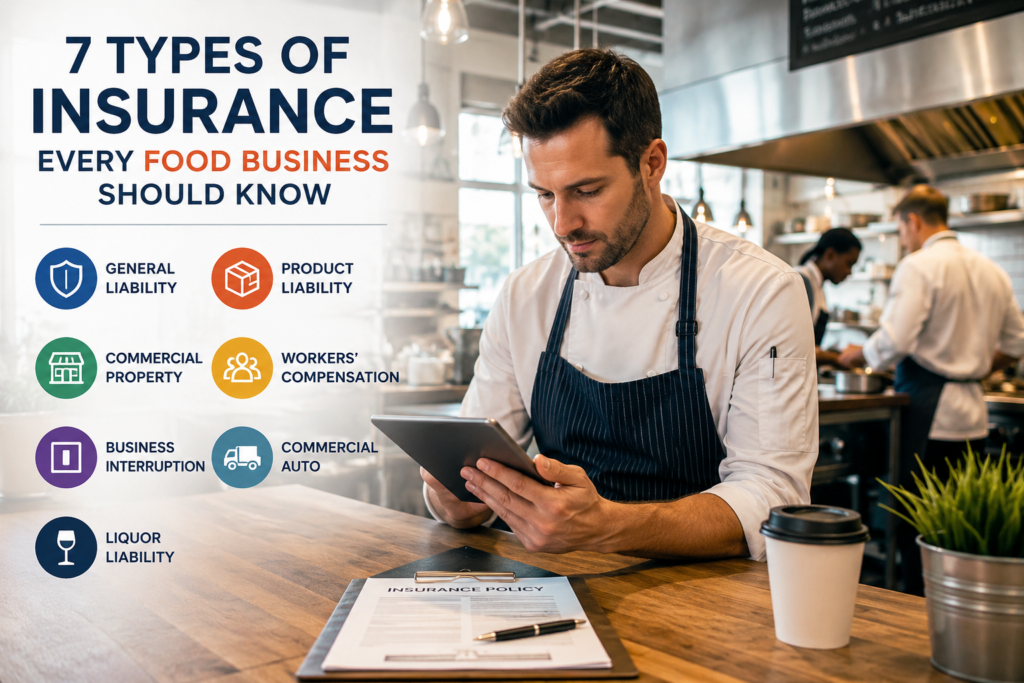
Other Insurance Coverage Food Businesses May Consider
Product liability insurance is important, but it may not be the only coverage a food company needs.
Depending on the business, other forms of insurance may include:
General Liability Insurance
This can address certain third-party bodily injury and property damage claims.
Commercial Property Insurance
This may protect eligible business property such as equipment, inventory, and other physical assets, subject to the policy.
Business Interruption Insurance
Business interruption coverage can help address certain income losses when a covered event causes a business to suspend operations. The NAIC notes that business interruption coverage is often included within a broader business owner’s policy.
Workers’ Compensation
Businesses with employees may have workers’ compensation obligations depending on applicable state law.
Commercial Auto Insurance
A food company using vehicles for business purposes may need commercial auto coverage.
The right combination depends on the company’s activities, location, size, employees, products, and risk profile.
How to Reduce Product Liability Risks
Insurance is only one part of protecting a food business.
Good risk management starts with prevention.
Maintain quality-control procedures
Create consistent processes for manufacturing, handling, packaging, and storage.
Keep supplier records
Maintain records of ingredients, suppliers, batches, and relevant documentation.
Review food labels carefully
Ingredient lists, allergen information, nutritional information, and other labeling requirements should be reviewed carefully.
Keep production records
Good documentation can become extremely valuable when investigating a product issue.
Monitor customer complaints
Repeated complaints about the same product should not be ignored.
Review your packaging
Packaging should protect the product and provide accurate information to consumers.
Review contracts
Manufacturers, distributors, retailers, and suppliers may have different responsibilities. Legal and insurance professionals can help businesses understand contractual requirements.
A Strong Brand Needs More Than a Great Logo
For a food company, branding is about trust.
A professional logo can make a product look memorable. Attractive packaging can help it stand out on a shelf. Clear messaging can communicate what makes the product different.
But behind the visual identity, consumers also expect a food company to take responsibility for quality and safety.
That is why food branding, packaging, quality control, and business risk management should be considered together.
A strong food brand is not simply a product with attractive packaging. It is a business that thinks about the complete customer experience—from the first impression on the package to the customer’s experience after purchasing the product.
Final Thoughts
Product liability insurance for food businesses can be an important consideration for companies that manufacture, distribute, or sell food products.
No insurance policy can eliminate business risk. However, appropriate coverage may help a company manage certain financial risks associated with covered product-related claims.
Food entrepreneurs should consider their products, sales channels, contracts, business size, and potential risks before selecting coverage.
Most importantly, don’t choose a policy simply because it is inexpensive. Read the terms, understand the exclusions, compare coverage limits, and speak with a qualified insurance professional about your specific business.
For a growing food brand, protecting the business can be just as important as creating a product customers love.
Frequently Asked Questions
What is product liability insurance for food businesses?
Product liability insurance is coverage designed to address certain financial losses arising from claims that a product caused injury or other covered harm. The exact protection depends on the policy.
Is product liability insurance required for food businesses?
Requirements vary depending on the business location, activities, contracts, and applicable laws. Some commercial partners may also require proof of insurance.
Is product liability insurance the same as general liability insurance?
No. They address different areas of risk, although product liability may be included within broader commercial liability coverage depending on the policy.
How much does food product liability insurance cost?
There is no standard price. Premiums can depend on the product, sales volume, location, claims history, coverage limits, deductible, and other risk factors.
Do small food businesses need product liability insurance?
Small businesses should evaluate their product-related risks and consider whether appropriate liability coverage makes sense for their operations.
Does insurance cover every food product claim?
No. Insurance policies have limits, conditions, and exclusions. Businesses should carefully review the policy before purchasing it.