

Starting a food business in the USA can require significant capital. Whether you want to launch a food truck, restaurant, packaged food brand, catering company, bakery, or specialty food product, finding the right investor can help you turn your idea into a growing business.
Unlike a traditional business loan, investment capital may allow you to raise money without taking on a conventional monthly loan payment. However, investors usually expect something in return, such as an ownership interest in the company or another form of financial return.
If you are looking for investors for your food business, this guide explains where to find them, what investors look for, how to prepare your business, and what to consider before accepting investment.
What Is a Food Business Investor?
A food business investor provides capital to a company with the expectation of receiving a financial return.
Depending on the investment structure, an investor may receive an ownership share in the business, repayment under a debt arrangement, or another investment interest.
Equity investment is different from a traditional business loan. With equity financing, the business gives an investor an ownership interest in exchange for capital. The Small Business Administration also notes that SBICs can invest in small businesses through debt, equity, or a combination of both.
For a food business, investors may be interested in:
- Restaurants
- Food trucks
- Packaged food brands
- Bakeries
- Catering companies
- Beverage companies
- Food manufacturing
- Specialty food products
- Food technology businesses
- Consumer food brands
Why Do Food Businesses Look for Investors?
Food entrepreneurs often need money for more than simply opening their doors.
Startup and expansion costs can include:
- Commercial kitchen equipment
- Restaurant equipment
- Food production machinery
- Packaging
- Inventory
- Product development
- Branding and marketing
- Website development
- Employees
- Rent and deposits
- Licenses and permits
- Distribution
- Retail placement
- Working capital
An investor may provide capital that allows a business to launch faster or expand into new markets.
For example, a packaged food company may need investment to purchase production equipment, develop packaging, build inventory, and enter retail stores.
Types of Investors for a Food Business
Not every investor is looking for the same type of opportunity. The right investor depends on your business model, stage, funding requirements, and growth potential.
1. Friends and Family Investors
Friends and family can sometimes be an early source of capital for a new food business.
They may invest because they already know and trust the founder.
However, you should treat the arrangement professionally. Clearly document:
- How much money is being invested
- Whether it is a loan or equity investment
- Ownership percentage
- Repayment terms, if applicable
- Investor rights
- What happens if the business fails
Mixing personal relationships with business investment without clear documentation can create problems later.
2. Angel Investors
Angel investors are individuals who invest their own money in businesses.
They can be particularly useful for food entrepreneurs who have a promising product but need capital to reach the next stage.
An angel investor may be interested in:
- A unique food product
- Strong sales growth
- A recognizable brand
- A large target market
- Strong founder experience
- Retail expansion opportunities
Some angel investors may also provide business connections and advice in addition to capital.
3. Venture Capital Firms
Venture capital is generally more appropriate for businesses with substantial growth potential.
A traditional local restaurant may not be the ideal fit for a venture capital firm. However, a food brand with a scalable product, strong consumer demand, and national expansion potential may attract venture investors.
Private funds commonly invest in businesses in exchange for equity, and some funds specialize in particular industries or stages of company development.
For example, a packaged food company that plans to expand from regional retailers into national distribution may have a stronger venture-capital story than a single-location restaurant.
4. Small Business Investment Companies
Another potential source of investment capital is an SBA-licensed Small Business Investment Company, commonly known as an SBIC.
According to the SBA, SBICs invest in small businesses using debt, equity, or a combination of both. The SBA provides financing support to qualified SBICs, which then invest in eligible small businesses.
SBICs typically evaluate factors such as:
- Business size
- Industry
- Location
- Company maturity
- Cash flow
- Growth potential
- Financing requirements
Not every startup will qualify, so entrepreneurs should check the requirements of individual investment companies.
5. Strategic Investors
A strategic investor may invest because your food business fits with their existing business interests.
For example, a food manufacturer, distributor, restaurant group, or consumer brand may have a strategic reason to invest in a smaller food company.
Strategic investors can potentially provide more than money. Depending on the agreement, they may offer:
- Distribution relationships
- Manufacturing resources
- Retail connections
- Industry expertise
- Marketing support
- Supply-chain relationships
However, entrepreneurs should carefully evaluate whether giving an investor ownership could limit future business decisions.
Where to Find Investors for a Food Business
Finding investors is not simply about asking people for money. You need to identify investors who are interested in your type of business.
Start With Your Professional Network
Your existing network can be one of the best places to start.
Talk to:
- Accountants
- Business attorneys
- Food industry professionals
- Restaurant owners
- Distributors
- Manufacturers
- Business consultants
- Entrepreneurs
- Retail buyers
- Local business organizations
The SBA specifically recommends using professional networks, including accountants, attorneys, and executives, when approaching SBICs.
A warm introduction can sometimes be more effective than sending a random investment proposal to someone who does not know your business.
Look for Food and Consumer Investors
Search for investors and investment firms that have experience with:
- Food and beverage
- Consumer packaged goods
- Restaurants
- Retail
- Food manufacturing
- Hospitality
- Consumer brands
An investor who already understands the food industry may understand your business model faster than someone who has never invested in the sector.
Attend Food Industry Events
Industry events can help entrepreneurs meet potential investors and strategic partners.
Consider attending:
- Food trade shows
- Startup events
- Entrepreneur conferences
- Food and beverage conferences
- Local business events
- Pitch competitions
- Industry networking events
The goal is not to immediately ask everyone for money.
Instead, focus on building relationships and finding people who understand your market.
What Do Investors Look for in a Food Business?
Investors generally want to know whether a business has the potential to produce an attractive return.
Some of the factors they may examine include:
Strong Product
Investors want to understand what makes your food product different.
Ask yourself:
- What problem does the product solve?
- Why would customers choose it?
- What makes it different?
- Can competitors easily copy it?
Market Demand
A great product is not enough if customers do not want it.
Evidence of demand may include:
- Sales
- Repeat customers
- Preorders
- Retail accounts
- Customer reviews
- Online demand
- Distribution agreements
- Growing revenue
Revenue and Growth
If your business is already operating, investors will likely want to see financial performance.
Important numbers may include:
- Monthly revenue
- Gross margin
- Net profit
- Customer acquisition cost
- Average order value
- Repeat purchase rate
- Revenue growth
Scalability
Investors often want to know whether the business can grow without costs increasing at the same rate.
A packaged food brand may have more scalability potential if its products can be manufactured and distributed across multiple states.
Experienced Management
Investors are also investing in the people behind the business.
Be prepared to explain:
- Your experience
- Your responsibilities
- Your team
- Your industry knowledge
- Why you are capable of executing the plan
Prepare Your Business Before Approaching Investors
Before contacting investors, make sure your business is organized.
At minimum, prepare:
- Business plan
- Financial projections
- Startup budget
- Sales information
- Marketing strategy
- Product information
- Ownership structure
- Funding requirement
- Use-of-funds plan
You should be able to clearly explain how much money you need and exactly what you plan to do with it.
For example:
We are seeking $250,000 to expand production, purchase equipment, build inventory, and launch our product in regional grocery stores.
That is much stronger than simply saying:
We need money to grow our business.
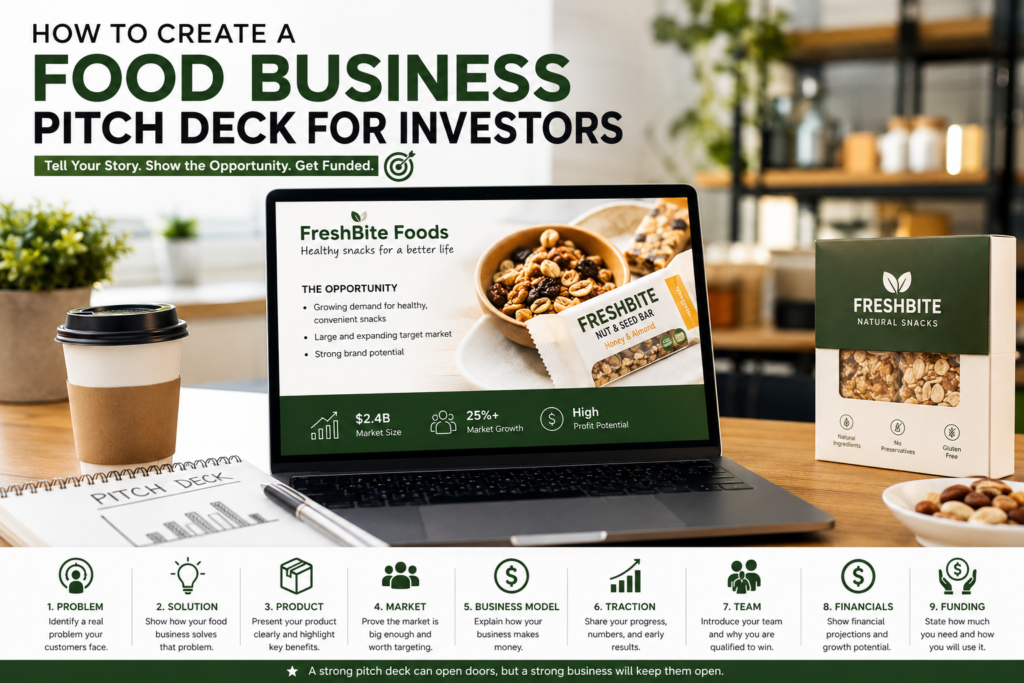
Create an Investor Pitch Deck
A pitch deck is a presentation designed to explain your business to potential investors.
A food business pitch deck might include:
- Company introduction
- Food product or concept
- Problem and solution
- Target customers
- Market opportunity
- Business model
- Current sales
- Marketing strategy
- Competitive advantage
- Growth plan
- Financial projections
- Funding request
- Use of funds
- Management team
- Investment opportunity
Your presentation should be simple and focused.
Investors should quickly understand what you sell, who buys it, how you make money, and why the business can grow.
How Much Money Should You Ask an Investor For?
There is no universal investment amount for every food business.
The amount should be based on your actual financial needs and growth plan.
For example:
Small Food Startup
You may need capital for:
- Equipment
- Initial inventory
- Packaging
- Licenses
- Website
- Marketing
Growing Food Brand
You may need more capital for:
- Manufacturing
- Employees
- Inventory
- Distribution
- Retail expansion
- Marketing
Instead of choosing a random investment amount, calculate your funding requirement based on your projected expenses and expected cash needs.
How Much Equity Should You Give an Investor?
This is one of the most important questions when raising investment.
If an investor provides money in exchange for equity, you are giving that investor an ownership interest in your company.
For example, suppose your company is valued at $1 million before investment and an investor invests $250,000.
The ownership calculation depends on the agreed valuation and deal structure.
You should not decide the percentage simply because an investor asks for it.
Before accepting an equity investment, understand:
- Company valuation
- Ownership percentage
- Voting rights
- Investor rights
- Future dilution
- Board rights
- Exit provisions
- Restrictions on selling shares
Because selling securities can involve federal and state securities laws, entrepreneurs should consult a qualified attorney before offering ownership interests to investors. The SEC states that private companies generally must either register securities offerings or rely on an applicable exemption.
Consider Crowdfunding as Another Investment Option
Some food businesses may also consider investment crowdfunding.
Under Regulation Crowdfunding, eligible companies can raise up to $5 million in a 12-month period through an SEC-registered intermediary such as a broker-dealer or funding portal. Certain disclosure and investor-limit requirements apply.
This can be interesting for consumer food brands because a company may already have customers who are interested in supporting the brand.
However, investment crowdfunding is not the same as simply creating a page and asking customers for donations. It involves securities regulations and specific compliance requirements.
What Investors May Ask You
Before meeting an investor, prepare for questions such as:
How much money have you invested yourself?
Investors may want to know how committed the founder is to the business.
How much revenue are you generating?
Be prepared to provide accurate financial information.
What is your profit margin?
Food businesses can have significant costs, so investors may want to understand your unit economics.
Who are your competitors?
Know the major competitors in your market.
Why will customers choose you?
Explain your competitive advantage.
How will you use the investment?
Break down the funding into specific categories.
How will the investor make money?
Be prepared to explain the potential return and investment structure.
Common Mistakes When Looking for Food Business Investors
Asking for Money Without a Plan
Investors need to know how their money will be used.
Giving Away Too Much Equity
Giving away a large ownership percentage too early can create problems as your business grows.
Ignoring Financial Numbers
A strong food product cannot replace accurate financial planning.
Approaching the Wrong Investors
A small local restaurant and a nationally scalable packaged food brand may need very different types of investors.
Making Promises About Returns
Never promise investors a guaranteed return.
Investment involves risk, and the actual outcome depends on the performance of the business and the terms of the investment.
Financing vs. Investment: What’s the Difference?
Financing and investment are related but different.
With a traditional business loan, you generally borrow money and repay it according to the loan terms.
With equity investment, an investor provides capital in exchange for an ownership interest or another investment arrangement.
The right option depends on your business.
For example:
Loan: You retain ownership but must repay the money.
Equity investment: You may not have traditional loan repayment obligations, but you give up some ownership.
Debt + equity: Some investment structures can combine both.
The SBA notes that SBIC financing can involve debt, equity, or a combination of the two.
Final Thoughts
Finding investors for a food business in the USA requires more than having a good food idea. You need a clear business model, realistic financial projections, evidence of market demand, and a convincing growth strategy.
Start by identifying the type of capital you actually need. Then look for investors who understand your industry and business model.
For a small startup, friends and family or angel investors may be potential sources of capital. A growing consumer food brand may consider strategic investors, venture capital, or other investment firms. Some eligible businesses may also explore investment crowdfunding or SBA-supported investment channels.
Most importantly, do not rush into an investment deal simply because someone offers you money. Understand the valuation, ownership terms, investor rights, and legal requirements before signing an agreement.
The right investor should provide more than capital. Ideally, they should also bring experience, relationships, knowledge, or resources that can help your food business grow.
Disclaimer: This article provides general educational information and is not legal, tax, accounting, or investment advice. Securities and investment rules can vary depending on the business structure, offering, investors, and state. Consult qualified legal and financial professionals before raising investment capital.