


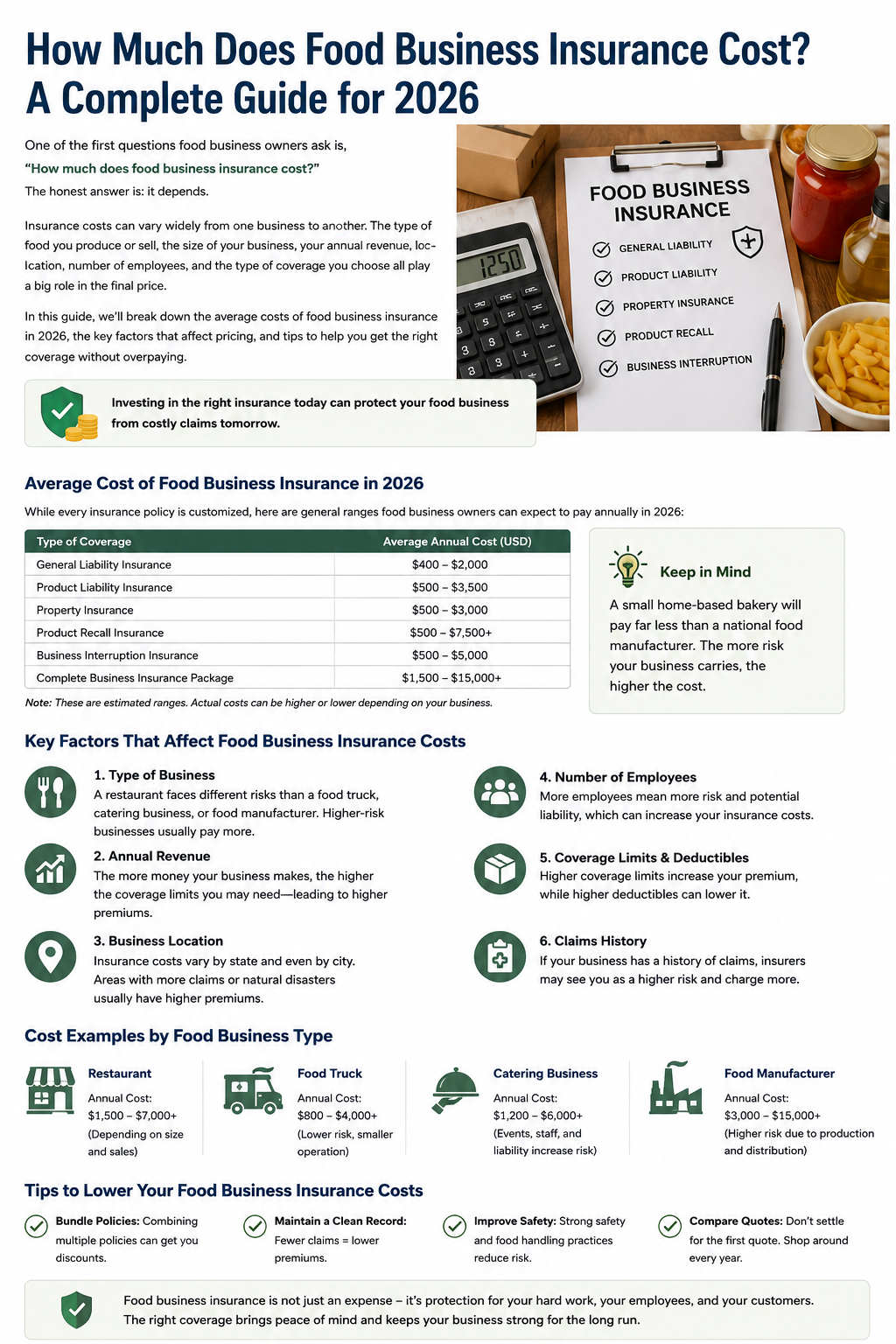
One of the first questions food business owners usually ask is simple: How much does food business insurance cost?
The honest answer is that there is no single price that applies to every food business.
A small home-based food business, a food truck, a busy restaurant, and a food manufacturing company all face different risks. As a result, their insurance premiums can be very different.
In 2026, food and beverage businesses can see insurance costs ranging from relatively modest premiums for small operations to several thousand dollars a year for businesses with employees, vehicles, commercial kitchens, large inventories, or significant product liability exposure.
For example, recent 2026 industry data puts the average overall insurance cost for food and beverage businesses at about $101 per month, or $1,209 per year, although this is a benchmark across many different types of businesses rather than a quote for a specific company.
A restaurant, food truck, or manufacturer can easily pay more depending on the coverage it needs.
In this guide, we’ll explain how food business insurance costs are calculated, what different types of food businesses may pay, which factors affect premiums, and how you can avoid paying for coverage you don’t actually need.
What Is Food Business Insurance?
Food business insurance is not one single policy.
Instead, it is a combination of insurance coverages designed to protect a food-related business from different financial risks.
Depending on the business, coverage may include:
- General liability insurance
- Product liability insurance
- Commercial property insurance
- Business owner’s policy (BOP)
- Workers’ compensation
- Commercial auto insurance
- Product recall or contamination insurance
- Business interruption insurance
- Equipment breakdown coverage
- Cyber insurance
- Liquor liability insurance, where applicable
A small food business may only need a few of these coverages, while a large food manufacturer may need a much broader insurance program.
This is one of the main reasons you should be careful when comparing insurance prices online. A $500 annual policy and a $5,000 annual policy may be covering completely different risks.
How Much Does Food Business Insurance Cost in 2026?
There is no universal rate, but current 2026 benchmarks provide a useful starting point.
For food and beverage businesses generally, one recent analysis found an average insurance cost of around $101 per month, or $1,209 per year, across 26 food and beverage subindustries.
However, individual business types can vary considerably.
For example, 2026 restaurant data shows a recommended restaurant insurance bundle averaging around $283 per month, or approximately $3,396 per year, for general liability, commercial property, and workers’ compensation for one employee.
Food trucks can cost more because they combine food-service risks with vehicle risks. One 2026 benchmark puts a recommended food-truck package at approximately $443 per month, or $5,301 per year, including commercial auto, general liability, and commercial property.
These figures are benchmarks, not guaranteed quotes.
Your actual premium may be substantially lower or higher.
Average Food Business Insurance Costs by Coverage
Here is a simple way to understand some common coverage costs in 2026.
| Coverage | Example 2026 Benchmark |
|---|---|
| General Liability | Around $525/year in one food-business benchmark |
| Business Owner’s Policy | Around $1,620/year |
| Workers’ Compensation | Around $1,380/year |
| Commercial Auto | Around $1,980/year |
| Liquor Liability | Around $900/year |
These figures come from a 2026 insurance-cost analysis and should be treated as general benchmarks rather than quotes.
Another 2026 analysis of food and beverage businesses found general liability costs commonly around $79 to $163 per month, depending on business size and type.
The difference between these figures shows why it is difficult to give one “average” price for every food business.
How Much Does General Liability Insurance Cost?
General liability insurance is one of the most common types of coverage for food businesses.
It can help protect a business against certain third-party claims, such as a customer injury or damage to someone else’s property.
For food and beverage businesses, recent 2026 benchmarks put general liability costs around $44 per month, or $525 per year, in one analysis.
But other datasets show considerably higher costs for particular food businesses.
For example, food trucks were reported at approximately $147 per month for general liability, or about $1,759 annually, in a 2026 benchmark.
Why such a large difference?
Because a food truck has additional risks that a small home-based food seller may not have.
The business’s size, location, revenue, customer volume, cooking methods, employees, and claims history can all influence the price.
How Much Does Product Liability Insurance Cost?
Product liability is particularly important for businesses that manufacture, package, distribute, or sell food products.
If a customer claims that a food product caused illness or injury, product liability coverage may help with certain covered claims and defense costs.
For small and midsize food companies, recent industry estimates put product liability costs roughly in the $800 to $3,000 per year range, although manufacturers and businesses with greater distribution exposure can pay substantially more.
Food manufacturers can face significantly higher premiums because they may produce large quantities of products and distribute them to many customers.
Some current industry estimates place food-manufacturing product liability premiums in the thousands of dollars per year, with the actual amount depending heavily on the operation.
How Much Does Restaurant Insurance Cost?
Restaurants usually need more than basic liability insurance.
Depending on the operation, a restaurant may need:
- General liability
- Commercial property
- Workers’ compensation
- Business interruption
- Equipment breakdown
- Liquor liability
- Cyber insurance
- Commercial auto or hired/non-owned auto coverage
Recent 2026 data puts a typical recommended restaurant bundle at approximately $283 per month, or about $3,396 per year.
Separate restaurant coverage can increase the total significantly.
For example, current 2026 data reported a median BOP cost of about $4,000 per year for full-service restaurants and around $3,200 for fast-food and carryout restaurants.
A restaurant serving alcohol may also need liquor liability coverage.
The larger the restaurant and the more employees, equipment, customers, and services it has, the more complicated its insurance needs become.
How Much Does Food Truck Insurance Cost?
Food trucks have a unique insurance situation because they combine two major risks:
food service + commercial driving.
A food truck may need:
- General liability
- Product liability
- Commercial auto
- Commercial property
- Workers’ compensation
- Equipment coverage
- Food spoilage coverage
- Cyber insurance
- Liquor liability, if applicable
A 2026 benchmark found a recommended food-truck package averaging about $443 per month, or $5,301 annually, for commercial auto, general liability, and commercial property.
Another current industry estimate puts many operating food trucks around $3,600 to $8,400 per year, depending on the operation and coverage selected.
The important thing is not to focus only on the lowest advertised price.
A cheap policy that doesn’t cover the risks your food truck actually faces may not be a good deal.
How Much Does Food Manufacturing Insurance Cost?
Food manufacturing is generally more complicated than running a small restaurant or food stall.
A manufacturer may have:
- Large production facilities
- Employees and machinery
- Warehouses
- Large inventories
- Distribution networks
- Product liability exposure
- Product recall exposure
- Business interruption risks
- Commercial vehicles
- Equipment breakdown risks
Because of this, insurance can cost substantially more.
One current 2026 analysis lists food manufacturing general liability at around $15,000 annually as a benchmark, although actual pricing depends heavily on the company’s size and risk profile.
Another industry source estimates that smaller food-manufacturing insurance programs can run into the $10,000–$30,000 annual range when multiple coverages are included.
These numbers illustrate an important point: there is a huge difference between insurance for a small food seller and insurance for a commercial food manufacturer.
What Factors Affect Food Business Insurance Costs?
Insurance companies don’t simply look at your business name and assign a price.
They look at the level of risk involved.
1. Type of Food Business
A home-based bakery, food truck, restaurant, catering company, and food manufacturer have different exposures.
For example, a food truck combines cooking risks with commercial driving, while a manufacturer may face larger product liability and recall exposure.
2. Annual Revenue
Revenue is often an important underwriting factor.
A company selling $50,000 worth of food products annually generally has a different exposure than a company generating several million dollars in sales.
Higher sales can mean more products in the marketplace and potentially greater liability exposure.
3. Number of Employees
More employees can mean higher workers’ compensation costs and potentially greater general liability exposure.
The type of work employees perform also matters.
Kitchen employees working around hot equipment, knives, fryers, ovens, and heavy machinery may present different risks than office employees.
4. Location
Where your business operates can have a significant impact on insurance costs.
Insurance pricing can vary by state and even by local area because of differences in claims, legal environments, property values, weather exposure, and other factors.
5. Cooking Methods
Cooking methods can affect risk.
A restaurant using deep fryers and open flames may have different insurance needs from a business selling prepackaged products.
Fire risk, kitchen equipment, ventilation systems, and safety procedures can all matter.
6. Claims History
A history of frequent or expensive insurance claims can make a business appear riskier to insurers.
A clean claims history may help a business qualify for better pricing, although it does not guarantee a discount.
7. Coverage Limits
Higher limits generally mean higher premiums.
For example, a business purchasing greater liability limits may pay more than a similar business with lower limits.
Some landlords, event organizers, retailers, or business partners may also require specific liability limits before they will work with you.
8. Deductible
The deductible is the amount the business agrees to pay before certain insurance benefits apply.
In some situations, choosing a higher deductible can reduce the premium.
However, the business should be financially comfortable with that deductible before choosing it.
9. Distribution and Delivery
A food business selling locally from one location may have less exposure than a company shipping products across multiple states.
Delivery vehicles, third-party transportation, warehouses, and distributors can all affect the overall risk profile.
10. Products You Sell
The type of food you produce or sell can also influence underwriting.
A business handling highly perishable foods, products with allergen concerns, or products distributed on a large scale may have different risks from a small business selling shelf-stable packaged goods.
Why Product Recall Insurance Can Increase the Cost
Food businesses sometimes assume that product liability insurance automatically covers product recalls.
It doesn’t necessarily.
Product liability and product recall coverage address different risks.
Product liability generally deals with certain third-party claims involving injury or property damage.
Product recall or contamination insurance can address certain eligible expenses involved in withdrawing an affected product from the marketplace.
That’s why a food manufacturer may need to consider both.
Dedicated product recall coverage can increase the total insurance cost, but for a business with significant product exposure, it may provide an important layer of protection.
Does a Business Owner’s Policy Save Money?
A Business Owner’s Policy (BOP) combines certain common coverages, typically general liability and commercial property, into one package.
For eligible businesses, bundling can sometimes be more economical than purchasing individual policies separately.
It can also make managing insurance easier.
However, a BOP does not automatically include every coverage a food business may need.
A food company may still need product liability, workers’ compensation, commercial auto, product recall, business interruption, or other specialized coverage.
So don’t assume that buying a BOP means your business is completely insured.
How to Lower Your Food Business Insurance Costs
Insurance is an important business expense, but there are sensible ways to manage the cost.
Compare Multiple Quotes
Don’t automatically accept the first quote you receive.
Different insurers can evaluate the same business differently.
Comparing several quotes can help you understand the market and identify unnecessary differences in pricing or coverage.
Bundle Appropriate Policies
If your business qualifies, combining certain coverages through a BOP or another package may reduce the overall cost.
Improve Food Safety
Strong food-safety procedures can help reduce the likelihood of incidents.
Maintain proper sanitation, temperature controls, employee training, supplier documentation, and product-traceability procedures.
Maintain Good Records
Keep accurate records of:
- Sales
- Payroll
- Inventory
- Suppliers
- Employees
- Safety training
- Previous claims
- Product testing
- Food-safety procedures
Good documentation can make the underwriting process easier.
Review Your Coverage Every Year
Your business may change significantly from one year to the next.
You might add employees, purchase new equipment, start selling online, begin shipping products to other states, or open another location.
Your insurance should change with your business.
What Is the Cheapest Food Business Insurance?
There is no single cheapest policy for every food business.
The cheapest policy is not necessarily the best policy if it leaves major risks uncovered.
For a very small food business, basic general liability may be relatively affordable.
For a restaurant, a BOP may make more sense.
For a food truck, commercial auto becomes essential because the business operates a vehicle.
For a food manufacturer, product liability, property, business interruption, and product recall coverage may become much more important.
The right question isn’t:
“What’s the cheapest insurance?”
A better question is:
“What coverage protects my business against the risks that could seriously damage it?”
Example: Comparing Three Food Businesses
Consider three fictional businesses.
Business A: Small Home Bakery
The owner sells cookies and cakes locally with no employees.
The business may have relatively modest insurance needs compared with a commercial manufacturer.
Its premium could be relatively low, depending on location, revenue, products, and coverage.
Business B: Food Truck
The owner operates one food truck and has several employees.
The business now has vehicle exposure, equipment exposure, customer exposure, and employee-related risks.
Insurance costs can therefore be considerably higher.
Business C: Packaged Food Manufacturer
The company manufactures sauces and distributes them through retailers.
Its exposure is much larger.
It may need general liability, product liability, commercial property, workers’ compensation, business interruption, commercial auto, and product recall or contamination coverage.
The annual insurance cost could therefore reach many thousands of dollars.
These examples show why an online “average food business insurance cost” should only be used as a starting point.
How Much Should You Budget for Food Business Insurance?
Instead of using one fixed number, think in terms of your business model.
A small food operation may be able to start with a relatively modest insurance budget.
A restaurant may need several thousand dollars annually for a broader package.
A food truck can also reach several thousand dollars annually because of commercial auto and other specialized coverage.
A food manufacturer may need a much larger insurance program because of its production, distribution, employee, property, and product risks.
The best way to create an accurate budget is to identify the coverage you actually need and then request quotes based on your real business information.
Final Thoughts
So, how much does food business insurance cost in 2026?
The answer depends on what kind of food business you operate and what risks you need to insure.
Current 2026 benchmarks show that food and beverage insurance can range from relatively low annual premiums for small operations to several thousand dollars or much more for restaurants, food trucks, and manufacturers.
Your business type, revenue, location, employees, claims history, cooking methods, products, vehicles, distribution area, coverage limits, and deductible can all influence the final premium.
Most importantly, don’t choose insurance based on price alone.
The cheapest policy may leave a serious gap when you need protection the most.
Instead, compare policies based on what they actually cover, understand the exclusions, and make sure the limits are appropriate for your business.
For food businesses, insurance should be viewed as part of a larger risk-management strategy that also includes food safety, employee training, product traceability, proper documentation, and a strong recall plan.
If you are also researching liability protection, read our related guide: General Liability Insurance vs. Product Liability Insurance for Food Businesses.
And if your business manufactures or distributes packaged food, our guide to Product Recall Insurance for Food Businesses can help you understand another important part of food-business risk management.
Frequently Asked Questions
How much does food business insurance cost per month?
It varies widely. A recent 2026 benchmark for food and beverage businesses puts the average at around $101 per month, but restaurants, food trucks, and manufacturers can be significantly higher depending on their coverage.
How much does restaurant insurance cost in 2026?
A 2026 benchmark puts a recommended restaurant insurance bundle at approximately $283 per month, or about $3,396 per year, although individual restaurants can pay considerably more or less.
How much does food truck insurance cost?
A 2026 benchmark puts a recommended food-truck package at about $443 per month, or $5,301 annually, for commercial auto, general liability, and commercial property. Actual costs vary by location, vehicle, employees, claims history, and coverage.
Is food business insurance required by law?
Requirements depend on the type of business, location, employees, vehicles, contracts, and other circumstances. Even where a particular policy isn’t legally required, landlords, event organizers, lenders, distributors, or customers may require proof of insurance.
Does food business insurance cover food poisoning?
Certain liability policies may provide coverage for covered claims alleging illness or injury caused by a food product. However, coverage depends on the policy wording, exclusions, circumstances, and applicable limits.
Does product liability insurance cover product recalls?
Not necessarily. Product liability and product recall insurance address different risks. A business should review its policy carefully rather than assuming recall expenses are covered.
Can I reduce my food business insurance premium?
You may be able to reduce costs by comparing insurers, bundling appropriate policies, improving safety procedures, maintaining a good claims history, and choosing deductibles and coverage limits carefully.
Should a small food business have insurance?
For many food businesses, insurance is an important way to protect against potentially expensive claims and unexpected losses. The appropriate coverage depends on the business’s activities, products, location, employees, and financial exposure.
Disclaimer: This article is for general educational purposes only and does not constitute legal or insurance advice. Insurance prices, requirements, coverage limits, exclusions, and availability vary by insurer, location, business type, and individual circumstances. Always review the actual policy and consult a qualified insurance professional before making an insurance decision.

